Have Additional Questions? Contact Us →

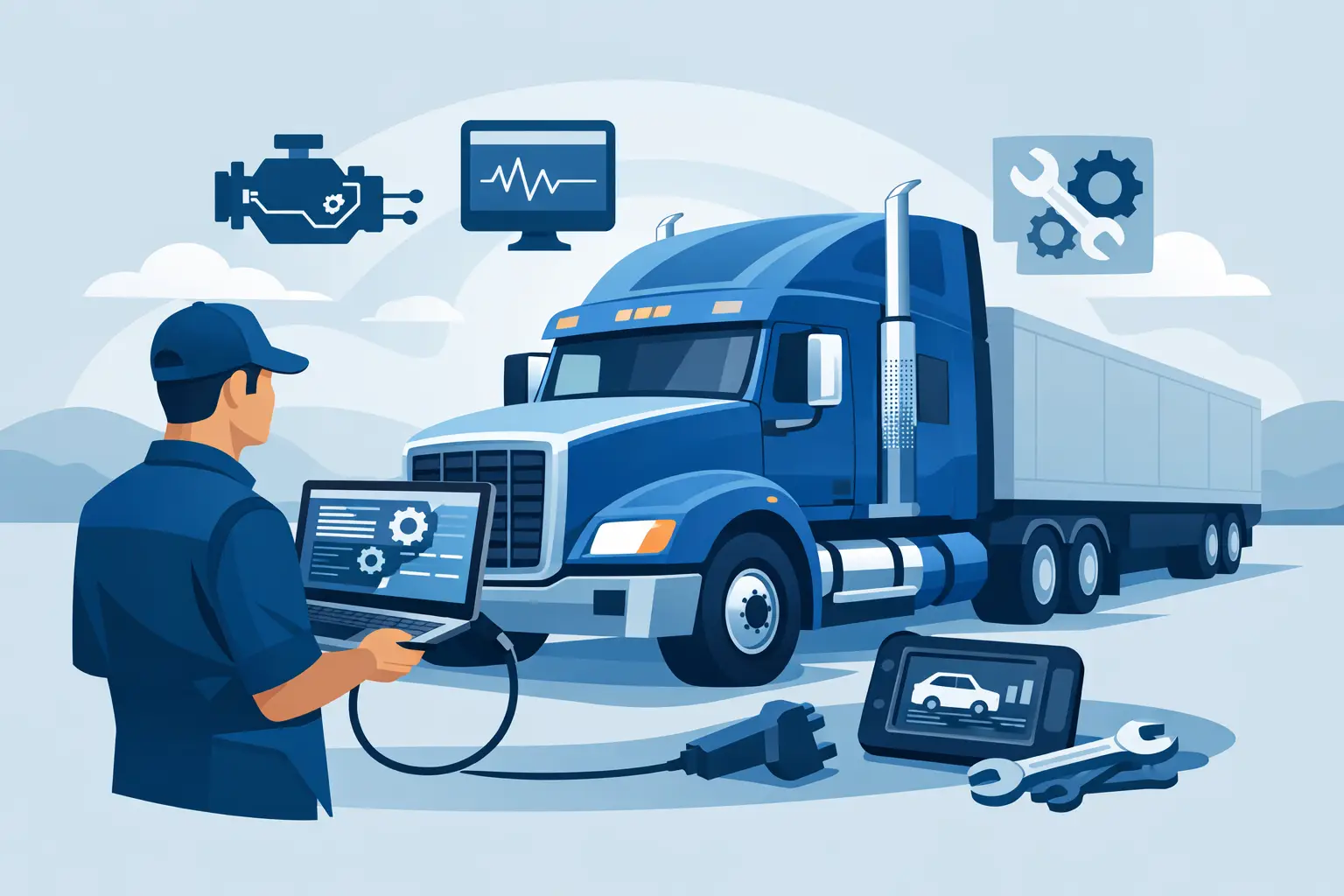
A replacement ECU has arrived, the vehicle is booked for collection at 4 pm, and the new unit still needs parameter setting before the lorry will behave properly on the road. That is where lorry coding tools stop being a nice extra and start being essential workshop equipment. In heavy vehicle work, coding is not just about turning options on or off. It is about getting control units, replacement parts and vehicle configuration to work together without wasting billable hours.
What lorry coding tools actually do
Lorry coding tools are used to write, adapt or confirm electronic settings inside vehicle systems after repair, replacement or retrofit work. On modern commercial vehicles, many parts are not simply plug-and-play. Injectors may need coding, ECUs may require parameter transfer, a used module may need adaptation, and certain systems need variant coding so the vehicle recognises what is fitted.
That matters across major brands including DAF, MAN, Iveco, Mercedes-Benz, Scania, Renault and Volvo. Even when fault diagnosis is straightforward, finishing the job can still depend on whether the workshop has the right coding capability. A lorry with a new control unit but incorrect configuration can show warning lamps, restricted functions or communication faults even though the hardware itself is sound.
In practice, coding work often sits between diagnostics and programming. Diagnostics tells you what is wrong. Programming may update software or write firmware. Coding sets the vehicle-specific values that let the system operate correctly in that exact chassis, engine and equipment combination.
Why generic diagnostic kit is often not enough
Many workshops start with broad multi-brand diagnostics, and that makes sense. For fault reading, live data and basic service functions, a good general tool covers a lot of ground. The problem comes when the job moves into deeper adaptation or brand-specific parameter work.
This is where the gap appears. A generic diagnostic platform may identify a module fault and even communicate with the replacement unit, but it may not support the coding path needed to complete installation. On some vehicles, it will offer partial functions only. On others, access may depend on security routines, brand-specific software structure or a more specialised interface.
For workshops handling heavy-duty vehicles every week, that difference affects turnaround. If your tool can diagnose but not finish the repair, the vehicle still occupies a bay and the operator still loses time. The cheaper option on paper can become the expensive one in daily use.
The main jobs lorry coding tools are used for
In real workshop conditions, coding usually appears during component replacement, retrofit work or electronic correction after previous repairs. Engine ECUs, AdBlue-related control units, body modules, gearbox systems and instrument clusters are common examples. The exact function depends on the platform, but the pattern is familiar: fit the part, establish communication, transfer or write the correct data, then confirm the system accepts the configuration.
Injector coding is one example mechanics already know well. Control unit replacement is another. Then there are jobs involving feature activation, module matching or restoring configuration after corruption or failed programming. On specialist commercial vehicles, coding may also be needed where auxiliary equipment or body-related electronics are involved.
For fleets with mixed EURO 5 and EURO 6 vehicles, the need is even more obvious. The emissions side of the vehicle adds more electronic dependency, more control units and more chances that replacement work will require proper coding rather than basic fault clearing.
Choosing lorry coding tools for a commercial workshop
The right choice depends less on headline features and more on the vehicles you actually see through the door. If your work is mainly one brand, deeper brand coverage usually matters more than broad vehicle count. If you handle mixed fleets, then multi-brand support becomes more valuable, but only if the coding functions are strong enough to be useful beyond basic service resets.
Compatibility should be checked at model level, not just manufacturer level. A tool may cover Mercedes-Benz in general terms, but the available coding functions for an Actros can differ from those for another heavy platform. The same applies across DAF LF variants, Scania heavy applications and specialist fleet configurations. Serious buyers check system coverage, function depth and model relevance before looking at price.
It is also worth paying attention to how the tool is delivered. Some buyers need a stand-alone device for quick workshop use. Others prefer interface-based solutions paired with software on a dedicated laptop. Neither is automatically better. Stand-alone tools can be quicker to deploy, while software-led systems often offer more specialist depth. It depends on your technicians, the complexity of the work and how you organise the bay.
What to check before buying
A coding tool should be judged on whether it saves time on real jobs, not whether the menu looks impressive. Start with supported brands and systems, then look at the actual coding and adaptation functions available for those vehicles. If the product information is vague, that is usually a warning sign.
Update policy matters as well. Commercial vehicle electronics do not stand still, and a tool without reliable update support can become limited faster than expected. Workshop buyers should also consider hardware quality, communication stability and whether technical guidance is available when a procedure does not behave as expected.
Support is not a minor issue in this market. Coding work can be straightforward on one vehicle and awkward on the next, especially when previous repairs, used parts or software mismatch are involved. Access to expert guidance by email can save a lot of dead time when a job does not follow the expected path.
Trade-offs that matter in daily use
There is no single best option for every workshop. A highly specialised tool may offer excellent depth for one manufacturer but sit idle when other vehicles come in. A broad tool may cover many brands but leave gaps on advanced functions. The right balance depends on your customer base and the kind of repairs you want to keep in-house.
Cost is another area where buyers need to be realistic. Workshop-grade lorry coding tools are not priced like entry-level car scanners, and for good reason. Commercial vehicles use more complex systems, the downtime cost is higher, and the buyer expects dependable function under pressure. What matters is whether the investment reduces subcontracting, repeat visits and lost workshop time.
There is also a skills trade-off. More capable equipment often asks more from the operator. A mechanic who is excellent with diagnostics may still need time to become confident with coding, parameter handling and module adaptation. That does not make the tool difficult in a bad sense, but it does mean training and process matter.
When coding tools and diagnostics need to work together
The best workshop setups do not treat coding as a separate world. They combine fault diagnosis, electrical checking and coding in one repair process. If a control unit is not coded correctly, fault codes and network issues follow. If the root cause is still present, coding alone will not rescue the repair. The technician needs both sides of the job.
This is especially true on emissions-related faults and electronic intervention work. A vehicle may present with SCR, AdBlue or communication issues that look like one problem but turn out to involve multiple modules and stored configuration errors. In those cases, coding capability adds value only when paired with proper diagnostic discipline.
For that reason, many professional buyers source coding equipment from specialist suppliers that also understand the wider lorry electronics market. Product range matters, but practical relevance matters more. If the supplier understands diagnostics, programming and vehicle-specific intervention tools, the advice tends to be more useful.
Who should invest in lorry coding tools
If your business replaces control units, handles fleet maintenance, repairs electronic faults or supports mixed commercial vehicle brands, coding capability is no longer optional. Independent lorry workshops, mobile lorry electronics specialists, fleet maintenance departments and resellers serving trade customers all benefit when they can complete electronic repair work without outsourcing the final stage.
For smaller operations, the decision is usually about frequency. If coding jobs appear once a month, a narrow purchase may not stack up. If they appear twice a week, the numbers change quickly. The more your workshop depends on keeping heavy vehicles moving, the easier it is to justify equipment that shortens repair time and improves first-time completion.
Truckdiag focuses on this end of the market for a reason. Buyers in commercial vehicle electronics do not need vague promises. They need the right tool for the right vehicle, clear compatibility, fast shipping and dependable support when workshop time is already under pressure.
The strongest buying decision is usually the simplest one: choose the coding tool that fits the vehicles you already service, the jobs you already lose time on and the level of technical work you want to keep under your own roof.
