Have Additional Questions? Contact Us →

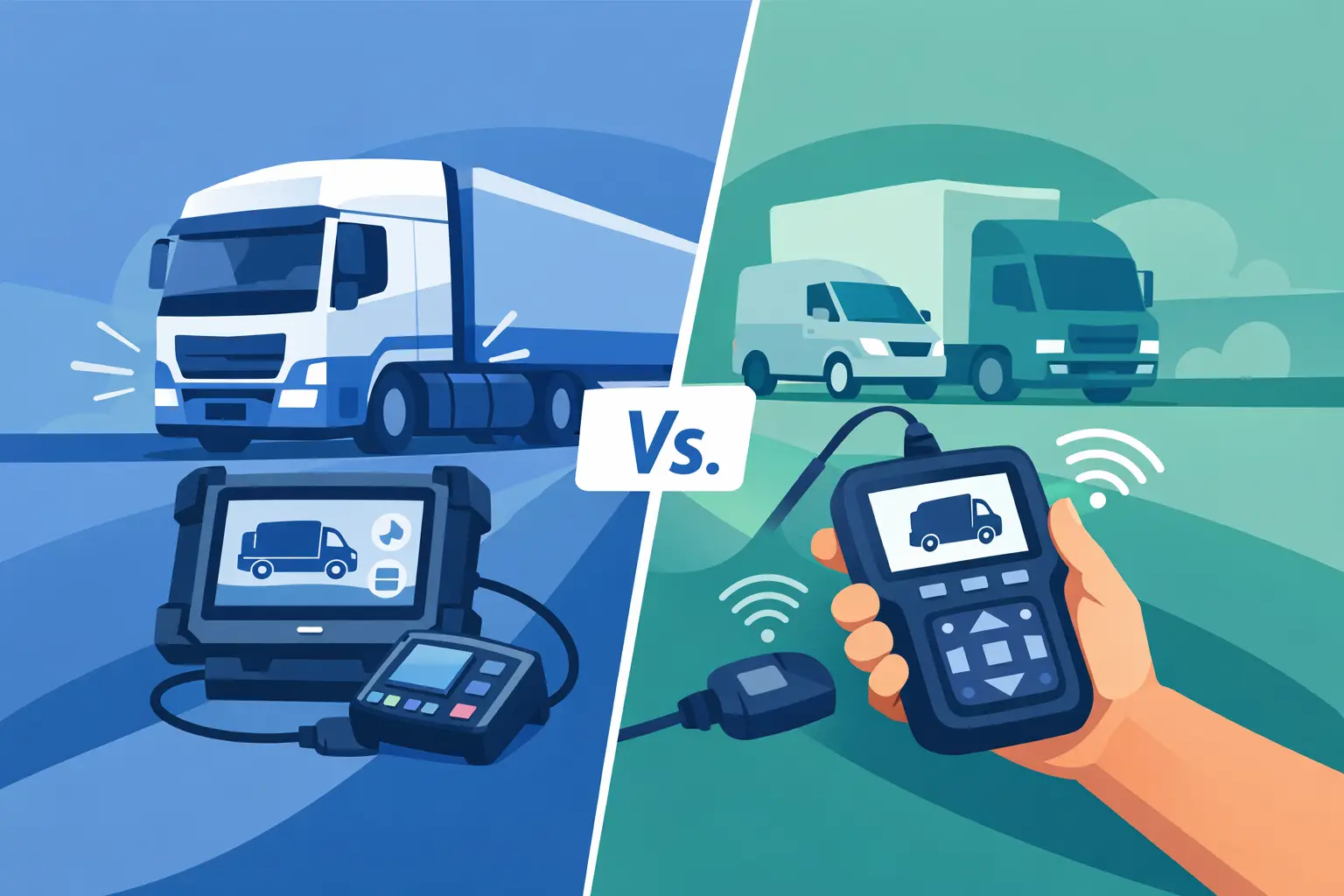
A warning lamp on a EURO 6 lorry is rarely just a warning lamp. It can lead to torque reduction, a failed regeneration, an AdBlue countdown or a vehicle that cannot return to work. The dealer tool versus universal scanner decision therefore affects more than fault-code reading. It determines how quickly your workshop can identify the real cause, carry out authorised functions and release the vehicle with confidence.
For commercial vehicle workshops, there is no single right answer. A manufacturer-level dealer tool offers the deepest access on its intended make, while a universal scanner gives an independent business practical coverage across a mixed fleet. The right purchase depends on the vehicles you see, the jobs you accept and the level of programming work you need to complete.
Dealer tool versus universal scanner: the real difference
A dealer tool is designed around one manufacturer’s electronic architecture. It generally uses the same diagnostic environment, communication methods and guided procedures supplied to authorised service networks. Depending on the system and subscription level, it can access full control-unit identification, live data, test plans, calibrations, adaptations, software functions and manufacturer technical information.
A universal scanner is built to communicate with many makes through one interface and software platform. Good commercial diagnostic systems cover standard powertrain functions across DAF, MAN, Iveco, Mercedes-Benz, Scania, Renault and Volvo, alongside other vehicle types. They are often quicker to deploy in an independent workshop because the technician works from one familiar menu structure rather than switching between several OEM applications.
The difference is not simply dealer equipment being “better”. It is depth versus breadth. A universal tool may read and clear faults, display live values, run common actuator tests and reset service data across many lorries. A dealer tool is more likely to expose manufacturer-specific routines when the fault is complicated, the control unit has been replaced or a software-related operation is required.
When a dealer tool earns its cost
Dealer-level equipment makes commercial sense when your work is concentrated on one marque or when you regularly undertake advanced electronic repairs. A specialist dealing mainly with Scania vehicles, for example, benefits from access to vehicle-specific parameter views and guided diagnostic paths that a multi-brand platform may not reproduce fully.
This matters most on jobs where generic fault descriptions are too broad. An SCR fault code may point to a dosing issue, but the underlying cause could involve supply voltage, tank quality data, a pressure reading, wiring resistance, NOx sensor plausibility or a control-unit condition that requires a specific test sequence. OEM software can provide the manufacturer’s intended workflow rather than leaving the technician to build it from separate readings.
Dealer systems are also the stronger option for authorised programming and configuration tasks. Injector coding, replacement module setup, immobiliser-related functions, parameter changes and software updates may need online access, security approval or a current manufacturer subscription. Coverage varies by brand and system generation, but the principle remains the same: if programming is a core revenue stream, buy tools with the required authorised capability rather than assuming a universal scanner will cover every procedure.
The trade-off is ownership cost and operational friction. A dealer tool may require separate hardware, licences, credentials, online access and recurring subscriptions for each manufacturer. It also demands technician training. For a workshop seeing only occasional examples of a particular brand, that investment can be difficult to recover.
Where a universal scanner is the better workshop tool
Independent commercial workshops commonly receive whatever arrives at the gate: a Volvo tractor unit in the morning, an Iveco rigid at lunchtime and a DAF fleet vehicle before closing. In that environment, a universal scanner is often the working tool that keeps diagnosis moving.
The main advantage is efficient first-line coverage. One system can identify the vehicle, scan installed control units, read fault memory, display live data and support routine service functions without maintaining a dedicated OEM setup for every make. This is valuable for fleet maintenance teams as well. A fleet with several marques needs fast visibility of faults and service status, not a separate diagnostic workstation for every vehicle bay.
A quality universal platform can be particularly useful for establishing whether a vehicle needs an electrical repair, a sensor replacement, a mechanical inspection or escalation to OEM-level programming. It helps technicians compare signals, check system voltages, confirm communication faults and verify whether a repair has removed the cause rather than merely clearing the warning.
Its limitation is that advertised model coverage does not always mean full functional coverage. A scanner may communicate successfully with the engine ECU but offer fewer tests for body systems, transmission functions, advanced ADAS calibration or the newest EURO 6 emissions modules. Always check the specific vehicle range, model year, engine variant and required function before buying.
SCR and emissions faults need more than code reading
Emissions systems are a common reason lorries enter the workshop with reduced performance. Yet a generic code read is only the starting point. Reliable diagnosis requires live values and a methodical check of the complete system, including battery condition, connectors, harness damage, pressure and temperature readings, dosing operation, NOx sensor data and stored fault history.
A dealer tool can provide deeper guided tests for a specific manufacturer. A universal scanner can still be highly effective for confirming common faults across a mixed fleet, provided its software supports the relevant control unit and live-data parameters. The critical point is to select diagnostics that match the work you actually perform.
Any repair or configuration work on an emissions system must comply with applicable roadworthiness, type-approval and emissions rules. A diagnostic tool should be used to identify and rectify faults properly, not to conceal them. For operators, a correctly repaired SCR system protects legal compliance, vehicle availability and long-term running costs.
Check these points before you buy
Before comparing headline prices, write down the vehicles in your workshop and the functions you need. Four checks prevent most disappointing purchases:
- Vehicle coverage: Confirm the manufacturer, series, engine generation and model year. A DAF LF, Scania R730 or newer EURO 6 vehicle may require different coverage from an older fleet model.
- Required functions: Separate fault reading and service resets from actuator tests, calibrations, coding, programming and online functions. These are not equivalent features.
- Update model: Ask whether the tool remains usable without updates, how often commercial vehicle coverage is added and what an annual subscription includes.
- Workshop support: Consider interface reliability, software installation, language options and access to technical guidance when a connection or function does not behave as expected.
Also consider the cost of delay. The cheapest scanner is not economical if it cannot access the module needed to diagnose a lorry sitting in the bay. Equally, a full OEM package is excessive if its advanced functions are used twice a year. Purchase for the jobs that generate regular labour, then build additional capability as demand proves itself.
A practical setup for independent workshops
For many businesses, the strongest arrangement is not dealer tool or universal scanner, but both in a planned order. Start with a capable multi-brand commercial diagnostic platform for everyday intake, fault finding and maintenance across makes. Add manufacturer-specific equipment where the vehicle volume or repair type justifies it.
This approach gives technicians a consistent first diagnostic process while retaining a route to deeper access. A universal scan can establish the system affected, capture fault details and highlight relevant live data. If the repair then requires protected programming, detailed guided testing or manufacturer-specific configuration, the correct dealer-level system can take over.
Keep equipment selection tied to your service offer. A mobile mechanic focused on fault finding and routine repairs needs broad coverage, durable hardware and fast vehicle identification. An electronics specialist working on control-unit replacement and coding needs deeper functions, stable power management and authorised access where required. A fleet workshop may prioritise rapid scanning, service planning and coverage for the marques it operates.
Truckdiag customers often work in exactly this mixed environment: practical diagnosis on varied commercial vehicles, followed by brand-specific electronic work where compatibility matters. Clear model information and a realistic view of required functions are more valuable than the largest feature list on a sales page.
Choose the tool that lets your technicians make the next correct decision quickly. When that decision is based on verified vehicle coverage, supported functions and the lorries actually entering your workshop, diagnostic equipment becomes a productive asset rather than another expensive item in the cabinet.
