Have Additional Questions? Contact Us →

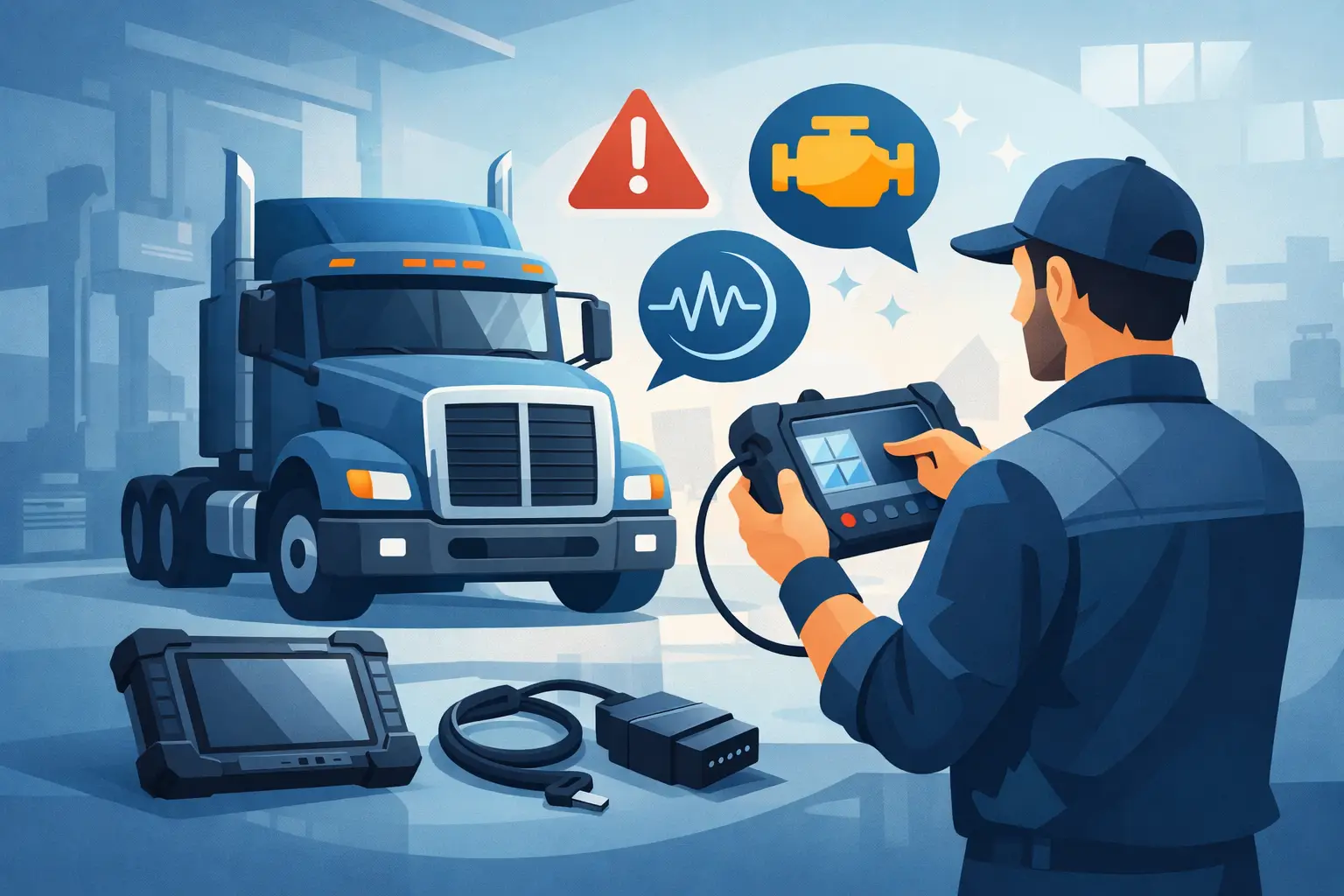
A warning lamp on a Euro 6 lorry is rarely a simple job. A generic reader may show a basic engine code, but it often cannot access the system that matters: EBS, retarder, body control, transmission, instrument cluster or the manufacturer-specific aftertreatment functions behind a torque reduction. The best lorry fault readers give a workshop a proper starting point, not a vague fault number and a parts-order gamble.
For fleet maintenance teams and independent commercial vehicle specialists, the right choice comes down to vehicle coverage, system depth and whether the tool can complete the repair after the fault has been identified. Reading and clearing codes is only the entry level. Live data, guided tests, adaptations, injector coding and service resets are what turn a diagnostic device into workshop equipment.
What separates the best lorry fault readers from basic scanners
A low-cost OBD reader can be useful for a quick check on a light commercial vehicle, but it is not designed around heavy-duty diagnostics. European lorries use manufacturer-specific networks and control units that require suitable protocols, software and vehicle cables. If the tool cannot communicate with the correct ECU, the code screen is of limited value.
A capable commercial diagnostic tool should identify the vehicle accurately and access the systems fitted to that chassis. On DAF, MAN, Iveco, Mercedes-Benz, Scania, Renault and Volvo vehicles, specification matters. A tool with broad brand coverage is useful, but the available functions for each make, model year and ECU are more important than a long compatibility list.
The better systems also present live values in a format a technician can use. For an SCR-related complaint, that means being able to check NOx sensor readings, exhaust temperature signals, AdBlue pressure, dosing status, tank level data and calculated inducement conditions. A stored code alone does not tell you whether the underlying issue is wiring, crystallisation, a sensor signal, pressure loss or a control-unit decision based on another fault.
Choose the reader around the work your workshop actually carries out
There is no single best tool for every operation. A mobile mechanic servicing mixed fleets has different requirements from an electronics specialist who regularly programs modules. Buying too little capability creates repeat visits. Buying an advanced platform without the support, updates or trained operator to use it properly is equally wasteful.
Multi-brand diagnostic platforms
For workshops seeing several European makes each week, a multi-brand heavy-duty platform is usually the practical option. It should cover engine, transmission, brakes, suspension, body systems and emissions control across the makes you service most often.
Look beyond the headline claim of “full system diagnosis”. Ask whether the package supports commercial vehicles rather than only cars, whether the necessary 6-pin, 9-pin or manufacturer-specific leads are included, and whether coverage extends to the older Euro 5 stock that still forms a large part of many fleets. Check how software updates are supplied and what happens once any included update period ends.
Multi-brand equipment is strong for fault finding, service work and routine maintenance. It is often the fastest way to get a vehicle through the door, assess its condition and establish a repair plan. However, its special functions may not go as deep as a manufacturer-level application on every vehicle.
Manufacturer-level software and interfaces
If your workshop concentrates on one make, dealer-level software with the correct interface can provide the deepest diagnostic path. It may offer guided fault finding, full parameter access, calibration routines, controller replacement procedures and more detailed technical information.
This route is particularly relevant for operations handling regular work on Scania, Volvo, DAF, MAN, Mercedes-Benz, Iveco or Renault lorries. It can also be the better choice when a repair requires configuration after fitting a new component, rather than a simple code clear.
The trade-off is cost, setup and process. Manufacturer systems can require a suitable laptop, controlled software versions, stable power supply and a technician who understands the consequences of programming. Do not treat coding as an extension of fault reading. Incorrect parameterisation can immobilise a vehicle or create further faults that take longer to resolve than the original complaint.
Handheld readers for roadside and fleet checks
A dedicated handheld heavy-duty reader suits operators who need quick confirmation at the yard or roadside. It can identify active and stored faults, show a limited set of live values and help a maintenance team decide whether a lorry can return to base or needs recovery.
This type of tool earns its place through speed and simplicity. It is not normally the best choice for ECU replacement, advanced calibration or detailed electrical testing. Fleet teams should see it as a first-response device, backed by a workshop-grade system for repairs.
The functions worth paying for
When comparing the best lorry fault readers, prioritise functions that reduce diagnosis time. Full-system scanning is the first requirement. An engine-only tool will miss brake, suspension and body faults that may be central to the driver’s report.
Live data is the next priority. A reader should let the technician view, and ideally graph, relevant sensor values while the fault is present. Freeze-frame information is also useful because it records operating conditions when a code was set. This can expose intermittent faults that do not appear during an idle test in the workshop.
Bi-directional tests are where a professional tool begins to pay back its purchase cost. The ability to command an actuator, request a test routine or verify a circuit response helps separate a failed component from a wiring or control issue. Use these functions carefully, following the vehicle procedure and with the vehicle secured appropriately.
Service functions matter as well. Depending on coverage, these can include oil and service resets, EBS procedures, steering-angle calibration, clutch or transmission adaptations, DPF service routines and component coding. Availability differs by vehicle, so verify the exact function before buying for a specific job.
Coverage and updates are part of the purchase price
Diagnostic tools age quickly when their software does not keep pace with vehicle electronics. A reader that works well on early Euro 6 lorries may not support newer controller variants, security requirements or recently introduced service routines. Check the update policy before committing, including annual subscription costs, update frequency and whether the supplier provides clear installation support.
Hardware support is just as important. Commercial vehicles are hard on connectors and cables. A kit should use reliable leads, have clearly identified adapters and offer replacements that can be obtained without delay. One damaged diagnostic cable should not hold up a booked job.
Compatibility needs to be checked by chassis and system, not only by badge. A DAF LF can differ from a long-haul DAF application, while special variants and model-year changes can affect both connectors and functions. Give the supplier the vehicle make, model, year, engine type and, where possible, VIN before ordering. That is faster than discovering a limitation after the vehicle is on the ramp.
Build a diagnostic process around the reader
Even the strongest diagnostic platform cannot compensate for a poor testing process. Start with a full vehicle scan and save the report before clearing anything. Record active, pending and historic faults, then compare them with the driver’s complaint and the vehicle’s operating conditions.
For emissions faults, inspect the basics before replacing expensive parts: battery voltage, fuses, connectors, harness routing, leaks, fluid quality and obvious exhaust damage. Follow with live-data checks and manufacturer-approved test routines. A fault code naming a NOx sensor does not automatically prove that the sensor is defective.
Clear faults only after the repair or test has been completed, then confirm the result with a key cycle, road test where appropriate and another scan. This protects the workshop from releasing a vehicle with an inducement condition still developing in the background. It also produces a clearer record for the customer or fleet manager.
All emissions-related repairs and programming should comply with applicable roadworthiness, type-approval and environmental rules. A fault reader is most valuable when it helps restore the vehicle’s original systems to correct operation, rather than masking a problem that can return as downtime, excessive emissions or a failed inspection.
Buy for support, not just specifications
The cheapest reader is rarely the lowest-cost option if it lacks cables, has uncertain updates or cannot perform the procedure you bought it for. Select a tool package that matches your regular vehicle parc, the depth of work you carry out and the level of technical help available when a difficult vehicle arrives.
Truckdiag focuses on specialist commercial vehicle diagnostics and can help buyers assess compatibility before purchase. That matters when the difference between a useful tool and an expensive drawer item may be one vehicle variant or one missing function.
A good fault reader should shorten the route from driver report to verified repair. Choose the one that gives your technicians credible system access, usable data and the right next action – then use it alongside sound electrical testing and manufacturer-approved repair information.
