Have Additional Questions? Contact Us →

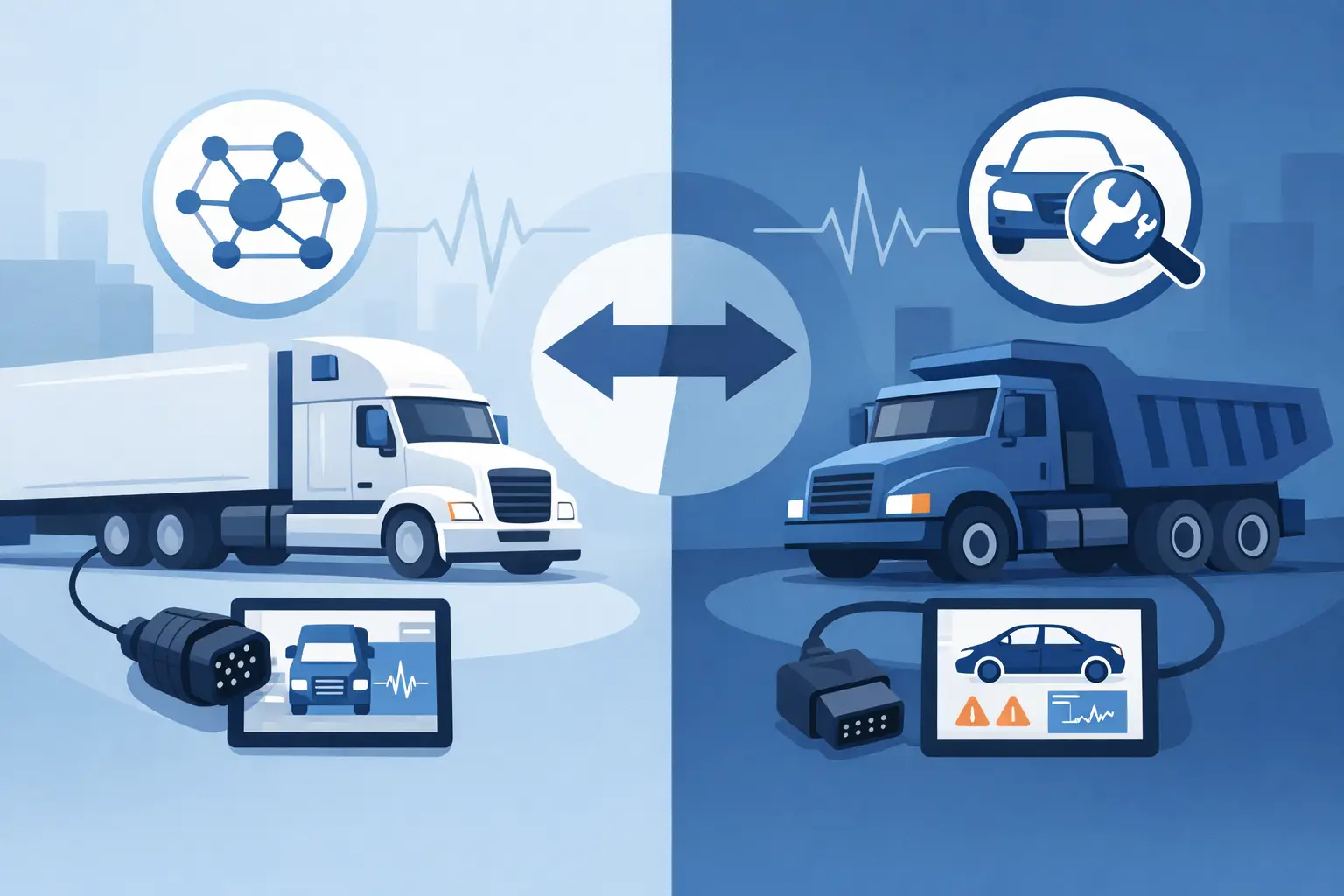
A warning lamp on a Euro 6 lorry does not automatically mean that a generic code reader will give the workshop the answer. J1939 versus OBD diagnostics is not simply a choice between two plugs or two software menus. It determines how much information you can see, whether the data is relevant to a heavy-duty control system, and how quickly the vehicle can return to work.
For fleet workshops, independent technicians and mobile service teams, the practical question is straightforward: does the tool communicate properly with the vehicle you are repairing? Understanding the difference prevents wasted diagnostic time, incorrect parts replacement and missed faults in systems such as SCR, EBS, transmission control and body electronics.
What OBD diagnostics are designed to do
OBD stands for On-Board Diagnostics. In the passenger vehicle world, OBD-II is the familiar standard behind the 16-pin diagnostic socket and broadly standardised emissions-related fault access. It was built to make emissions monitoring more consistent across light vehicles and to provide a common starting point for reading diagnostic trouble codes.
On a car or light commercial vehicle, an OBD reader may retrieve engine fault codes, identify a malfunction indicator lamp request, show basic live values and provide readiness status. This is useful for first checks, emissions-related investigation and simple service work.
The limitation is scope. Generic OBD equipment normally sees a restricted set of standardised information. Manufacturer-specific modules and functions may be unavailable, incomplete or described too generally to support a repair decision. A reader might report an emissions-related code, for example, without giving the full operational context needed to determine whether the cause is a sensor, wiring fault, dosing issue, air supply problem, CAN communication fault or a control-unit strategy condition.
OBD also does not mean that every 16-pin socket gives the same access. Connector shape, installed software and actual protocol support are separate matters. A basic tool can physically connect while still being the wrong tool for the vehicle.
What J1939 brings to commercial vehicle diagnostics
SAE J1939 is a communication standard widely used in heavy-duty vehicles and equipment. It operates over CAN networks and is designed around the needs of commercial applications, where multiple electronic control units exchange operational data continuously.
Instead of relying only on generic OBD parameter access, J1939 uses standardised messages known as Parameter Group Numbers, or PGNs. Individual signals within those messages are identified as Suspect Parameter Numbers, or SPNs. When a fault is detected, it is commonly reported with an SPN and a Failure Mode Identifier, known as an FMI. A fault record may also include an occurrence count.
That structure matters in a workshop. An SPN identifies the parameter or system area at fault, while the FMI indicates the type of failure, such as voltage above normal, voltage below normal, data erratic, mechanical system not responding or a value out of range. This is far more useful than treating every warning lamp as a single generic engine issue.
A J1939-capable diagnostic platform can therefore support fault finding across engine management, aftertreatment, braking, gearbox, suspension, instrument systems and other networked functions, depending on the vehicle and the software licence. It can also show live broadcast data from multiple modules, which is valuable when a fault occurs only under load, at a certain temperature or during a specific operating sequence.
J1939 versus OBD diagnostics: the workshop difference
The clearest difference is that OBD was developed primarily to provide common emissions-related access, while J1939 was developed for broader heavy-vehicle electronic communication. Both can have a place in a professional environment, but they are not interchangeable.
A generic OBD tool can be useful for quick checks on compatible vehicles. It is often affordable, portable and sufficient when the job is limited to basic fault-code retrieval. For a mixed workshop that also handles cars and vans, it remains a sensible item in the tool cabinet.
J1939 diagnostics are the more appropriate starting point for most modern lorries, buses, agricultural machines and construction equipment using heavy-duty CAN architecture. The technician can work with commercial-vehicle fault language, assess data from relevant controllers and follow a structured test plan. That reduces the risk of diagnosing only the symptom visible through an OBD interface.
However, J1939 is not a magic universal key. Vehicle manufacturers add their own diagnostic services, controller logic, security arrangements and proprietary functions. A tool may read standard J1939 faults yet lack the ability to perform guided tests, coding, calibration, actuator commands or service resets on a specific DAF, MAN, Iveco, Mercedes-Benz, Scania, Renault or Volvo model. For those tasks, dedicated multi-brand lorry software or manufacturer-level equipment may be required.
Why fault codes must be read in context
An SPN/FMI fault description is a starting point, not a parts order. For instance, an aftertreatment-related code may point to an implausible reading, but the source can be a damaged harness, poor earth, connector corrosion, supply-voltage issue, failed sensor or incorrect data sent by another controller.
The same principle applies to network faults. A J1939 communication error can result from an isolated module, damaged twisted pair, incorrect terminating resistance, water ingress, low battery voltage or a controller that is pulling the CAN network down. Clearing the code and waiting for it to return is rarely a complete diagnostic method.
Use the code together with freeze-frame information where available, live data, wiring diagrams, pin checks and a visual inspection. Check whether the fault is active or stored, whether it appears across more than one control unit and whether it changes when the harness is moved or a load is applied. On a working vehicle, the conditions surrounding the fault are often as useful as the code itself.
Choosing the right diagnostic equipment
Tool selection should begin with the vehicles actually entering the workshop. A fleet operating mainly Euro 5 and Euro 6 tractor units needs different coverage from a garage servicing light vans alongside occasional rigid lorries. Check supported brands, model years, system coverage, connector requirements and included software before purchase.
For heavy-duty work, look beyond the headline claim that a device supports J1939. Confirm whether it can read and clear faults from the relevant modules, display live data, carry out actuator tests, access SCR and AdBlue systems, support EBS and transmission functions, and perform coding or calibration where required. Update availability is equally relevant because later vehicle variants can introduce new controllers and functions.
The interface hardware also matters. Commercial vehicle diagnostics may require 6-pin, 9-pin, 16-pin or manufacturer-specific connections. A quality interface and correct adapter lead help avoid intermittent communication that can be mistaken for a vehicle fault. Keep leads labelled, inspect pins regularly and avoid forcing connectors into sockets that do not match.
For advanced electrical work, diagnostic software should be paired with the basics: a suitable multimeter, battery support equipment, wiring information and, where necessary, an oscilloscope. Software identifies where to investigate. Electrical tests establish whether the vehicle circuit and component are actually behaving as expected.
Common mistakes that cost workshop time
The first mistake is assuming that an OBD code description is complete. On commercial vehicles, generic text can be too broad to support a reliable repair. The second is buying a tool based only on brand coverage, without checking whether it supports the exact model, system and function needed.
Another common error is diagnosing with weak batteries or unstable supply voltage. Low voltage can create multiple unrelated-looking controller faults, especially after the vehicle has stood or during repeated ignition cycles. Stabilise the electrical supply before judging communication and module status.
Finally, do not overlook configuration and legal compliance. Coding, emissions-system repairs and electronic intervention should be carried out only with the correct equipment, technical data and authority for the vehicle’s operating jurisdiction. A fast fix that creates a non-compliant vehicle or hides the original defect is not a workshop-quality repair.
Build diagnostics around the job, not the connector
The right approach is to match the diagnostic platform to the vehicle architecture and the work your business carries out. Use OBD where its standardised access is sufficient. Use J1939-capable and manufacturer-aware equipment when the repair involves heavy-duty systems, detailed live data or commercial-vehicle fault analysis.
For workshops dealing with modern European lorries, compatibility accuracy is worth more than a cheap universal reader. Select equipment that supports the vehicles on your ramps, maintain it properly and use the data alongside sound electrical testing. That is how diagnostic time becomes productive workshop time rather than another source of vehicle downtime.
