Have Additional Questions? Contact Us →

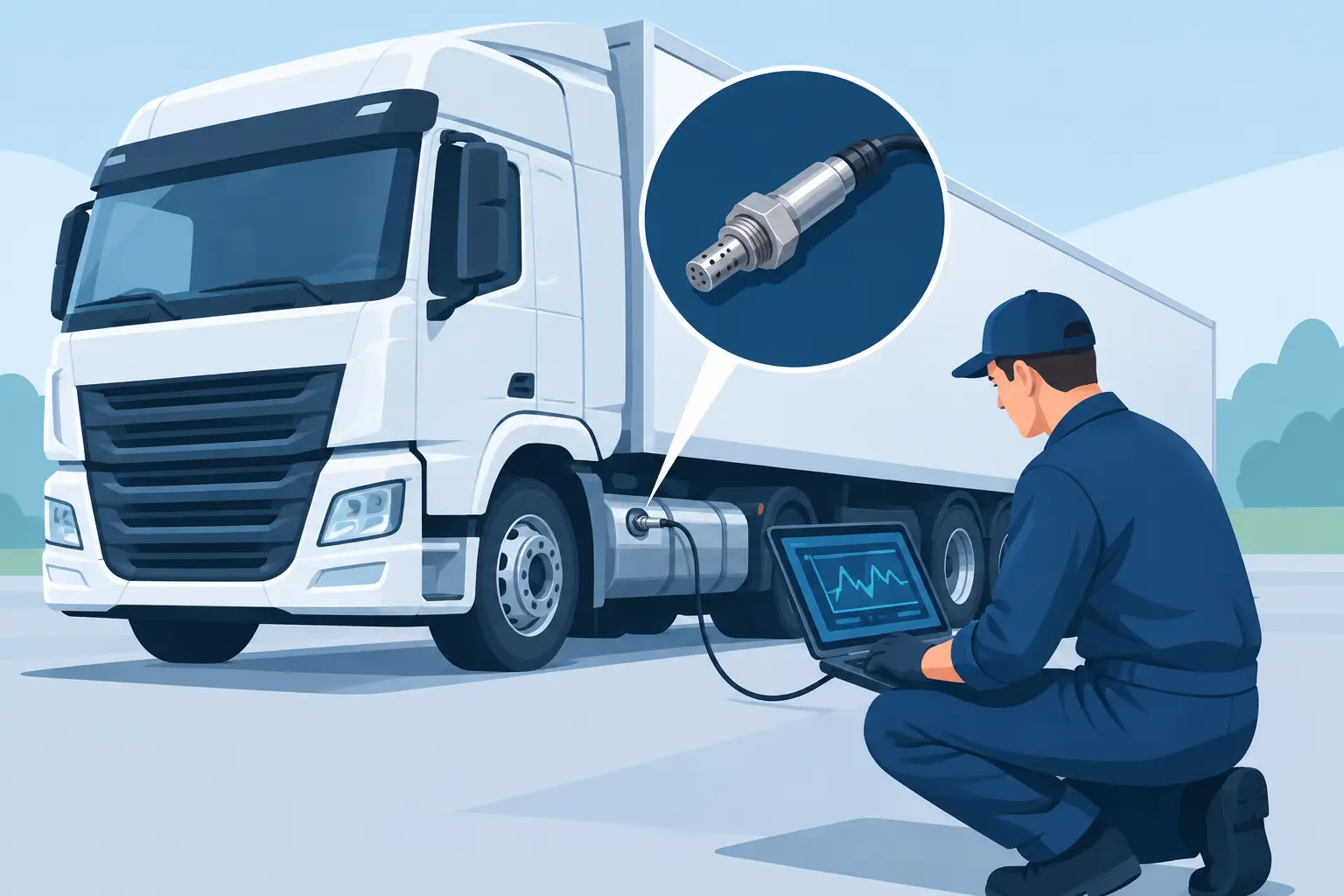
A NOx sensor fault can turn a serviceable Euro 5 or Euro 6 lorry into a downtime problem very quickly. Warning lamps, AdBlue messages, torque limitation and a countdown to no-start are familiar symptoms, but replacing the sensor from the first fault code is often an expensive guess. Knowing how to diagnose NOx sensor faults properly means checking the whole SCR system: sensor plausibility, power supply, wiring, exhaust conditions and the quality of the reductant system data.
NOx sensors are not simple exhaust probes. Most heavy-duty units contain a sensing element and an integrated control module, communicating with the engine ECU over CAN. A fault may therefore be caused by the sensor itself, but it can also come from heat-damaged wiring, low system voltage, poor earths, CAN communication issues, exhaust leaks or an SCR system that cannot reduce NOx as expected.
Start with the complaint and fault memory
Record the driver’s complaint before clearing anything. Ask whether the warning occurred after a long motorway run, in cold weather, after an AdBlue refill, following exhaust work or immediately after another repair. These details can separate an intermittent connection issue from a genuine emissions-performance failure.
Connect a suitable heavy-duty diagnostic tool and carry out a full vehicle scan, not only an engine ECU scan. On DAF, MAN, Iveco, Mercedes-Benz, Scania, Renault and Volvo platforms, SCR-related information may be shared between the engine management system, aftertreatment controller and dash display. Save the fault codes, freeze-frame data and current status before clearing them.
Codes generally fall into four useful groups:
- heater circuit, internal control unit or sensor-element faults;
- supply voltage, earth, CAN high or CAN low faults;
- signal range, plausibility or response-time faults; and
- SCR efficiency faults, where measured downstream NOx remains too high.
The final group needs the most care. A downstream NOx reading may be correct while the actual fault lies with dosing, DEF/AdBlue quality, catalyst condition or an exhaust leak. Treat a NOx efficiency code as a system test result, not automatic proof of a failed sensor.
Identify which NOx sensor is reporting the fault
Many Euro 6 lorries use two NOx sensors. The upstream sensor is fitted before the SCR catalyst and measures engine-out NOx. The downstream sensor sits after the SCR catalyst and is used to assess conversion efficiency. Exact positions vary by chassis and engine family, so confirm the vehicle wiring diagram and parts information before ordering or testing.
An upstream sensor that reads implausibly low or high can affect calculated dosing demand. A downstream sensor that reports excessive NOx can trigger SCR performance warnings and derate strategies. However, both readings must be interpreted alongside exhaust temperature, engine load, AdBlue dosing command and catalyst conditions.
Do not assume sensors are interchangeable because the connectors look alike. Their calibration, software version, lead length and installation location can differ. Vehicle identification number, engine code and emissions level matter when selecting a replacement.
Read live data at the right operating conditions
Start the engine and allow it to reach normal operating temperature. A cold idle test has limited value because the SCR catalyst may not yet be active and NOx sensor heaters may still be operating. Check battery voltage first. Low voltage during cranking or idle can create false communications and heater faults.
With live data open, monitor upstream and downstream NOx values, exhaust gas temperatures, calculated SCR efficiency, AdBlue tank level, pump pressure where available, dosing status and sensor supply voltage. Raise engine speed or carry out a controlled road test only when safe and permitted by workshop procedures.
At a stable load and adequate exhaust temperature, the downstream NOx value should normally be materially lower than the upstream value once the SCR system is dosing correctly. There is no single figure that proves a sensor is good across every engine. Ambient temperature, load, exhaust temperature and ECU strategy all affect the readings. What matters is whether the values are plausible, responsive and consistent with the dosing state.
A sensor stuck at one value, showing an impossible value, remaining unavailable after warm-up or dropping in and out with vibration is suspicious. Compare its behaviour with exhaust temperature and engine load. If upstream NOx remains unchanged from idle to loaded operation, investigate the sensor and its wiring. If downstream NOx remains high while upstream data is believable, test the SCR system before condemning the downstream sensor.
Check the sensor, connector and harness
Switch off, follow the manufacturer’s power-down procedure and allow the exhaust to cool before touching the sensor. These components operate at high temperature, and the control module and connector are often mounted close to severe heat and road contamination.
Inspect the complete harness route, not just the plug. Look for melted insulation near the exhaust, chafing at brackets, stretched wiring, water entry, green corrosion in terminals and unsecured module mounts. On fleet vehicles, damage after roadside exhaust work or a failed DPF clamp is common.
Check that the connector is fully latched and that no terminals are pushed back. Do not force test probes into sealed terminals. Use the correct breakout leads or back-probing method, as terminal damage can create an intermittent fault that was not present beforehand.
Using the manufacturer wiring information, verify the sensor’s permanent or switched supply, ignition feed where fitted, earth integrity and CAN circuit. A voltage-drop test under load is more useful than simply checking continuity. A wire can show continuity with a multimeter and still fail when the harness warms up, vibrates or carries current.
For CAN-related codes, inspect network condition before fitting a sensor. Check for damaged twisted-pair wiring, poor ECU connections and other active communication faults. A NOx sensor cannot report correctly if it is not receiving stable power and network communication.
Avoid resistance tests on the sensor element
Do not apply generic oxygen-sensor testing methods to a commercial-vehicle NOx sensor. These units contain electronics and a heater controlled by the module. Measuring resistance at the wrong pins or applying an external supply can damage the unit or create misleading results.
Use scan-tool actuator tests and manufacturer test routines where available. Some platforms can run a NOx sensor functional check, heater assessment or SCR efficiency test. Follow the prompted preconditions exactly, especially exhaust temperature, fuel level, air pressure and parked-regeneration status.
Rule out the faults that imitate a bad NOx sensor
A sound sensor can report an SCR problem accurately. Before replacing a downstream unit for low conversion efficiency, inspect for an exhaust leak upstream of the sensor or around the catalyst. Fresh air entering the exhaust can distort readings and reduce effective aftertreatment performance.
Then check AdBlue quality and contamination risk. Incorrect fluid, crystallisation in the dosing line, a blocked injector, low pump pressure or poor atomisation will prevent correct NOx reduction. Inspect the dosing injector for deposits and confirm it is not leaking when commanded off. Any dosing test must follow the vehicle manufacturer’s safety instructions, as AdBlue is corrosive to some materials and crystallises quickly.
Exhaust temperature is equally significant. SCR conversion requires suitable temperature conditions. If temperature sensors report incorrectly, the ECU may limit dosing or interpret catalyst performance incorrectly. Check associated exhaust temperature and differential-pressure faults, as DPF restriction and incomplete regeneration can influence exhaust heat and emissions behaviour.
Catalyst ageing is also possible on high-mileage vehicles, particularly where there has been repeated contamination, prolonged poor-quality reductant use or unresolved engine faults. Diagnose this only after confirming that sensors, dosing, temperatures and exhaust integrity are correct. Replacing a catalyst before completing these checks is rarely cost-effective.
Clear codes, prove the repair and document it
After a wiring repair, sensor replacement or SCR-system repair, clear faults only when the underlying cause has been addressed. Run the required service routine and road-test the vehicle until the ECU has completed its monitor conditions. Some faults will not change to inactive until the exhaust reaches temperature and the lorry has operated under a defined load.
Recheck stored and pending codes, live NOx values and warning status after the test. Record the original codes, measured data, repairs completed and part numbers fitted. This protects the workshop if the vehicle returns and helps fleet maintenance teams spot repeat issues across similar vehicles.
Fit only the correct approved sensor for the vehicle and keep the emissions system operating as designed. Bypassing or disabling emissions equipment can create legal, inspection, warranty and fleet-compliance problems, while also masking the real fault.
A disciplined diagnosis takes longer than swapping a sensor, but it prevents repeat derates and unnecessary parts costs. When the data, wiring and SCR conditions all point in the same direction, the repair decision becomes clear and the lorry can return to work with confidence.
