Have Additional Questions? Contact Us →

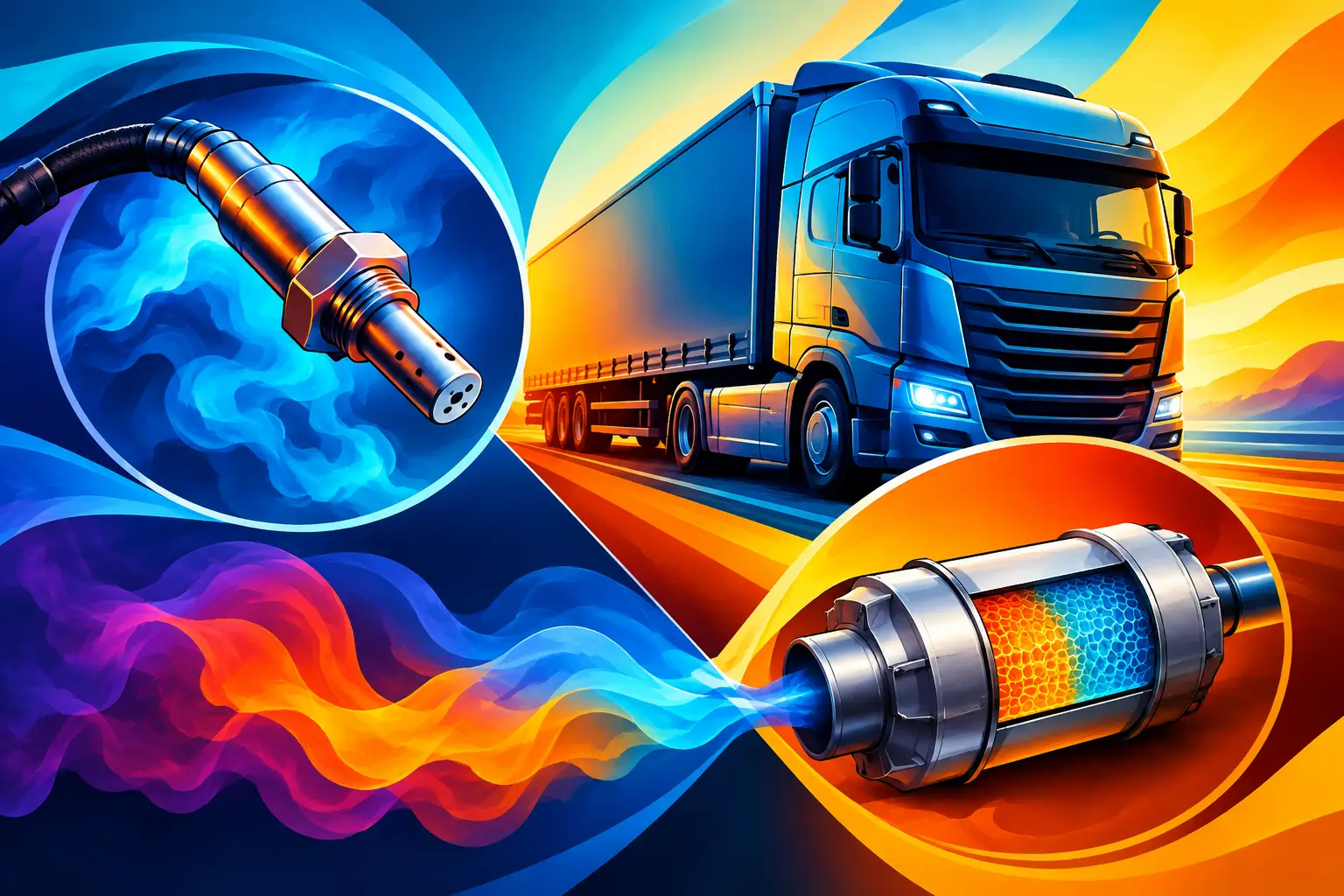
A Euro 6 lorry can show an SCR warning, engine fault code and countdown message when the actual defect is a failed NOx sensor. Equally, replacing the sensor first can waste time and money when the real issue is poor AdBlue dosing, crystallisation or an SCR catalyst that is no longer converting NOx effectively. Understanding the NOx sensor versus SCR fault distinction is what stops a workshop from fitting parts by guesswork.
The symptoms overlap because the engine ECU uses NOx sensor feedback to control and monitor the entire selective catalytic reduction system. A bad reading may be treated as an emissions failure. A genuine emissions failure may look like a sensor reporting problem. The diagnostic route must separate the measured value, the sensor circuit and the actual exhaust aftertreatment performance.
NOx Sensor Versus SCR Fault: What Is Being Tested?
An SCR system reduces nitrogen oxides in the exhaust by injecting AdBlue upstream of the SCR catalyst. Once exhaust temperature is sufficient, the dosed fluid breaks down into ammonia, which reacts in the catalyst and reduces NOx emissions. The system depends on correct dosing, suitable exhaust temperature, a healthy catalyst and accurate feedback from the sensors.
Most modern heavy-duty applications use an upstream NOx sensor before the SCR catalyst and a downstream sensor after it. The upstream sensor reports engine-out NOx. The downstream sensor helps the ECU assess catalyst efficiency and dosing control. On some vehicle platforms, sensor layout and fault strategy vary, so always use the correct wiring information and diagnostic software for the exact engine and Euro rating.
A NOx sensor fault means the ECU cannot trust the signal, heater operation, communication or plausibility of that sensor. An SCR fault means the system has detected poor NOx conversion or another condition preventing normal emissions control. The two are related, but they are not interchangeable diagnoses.
Signs That Point to a NOx Sensor Problem
A failed NOx sensor often produces a fault code that identifies the sensor position, circuit or internal electronics. Common wording includes signal implausible, heater malfunction, communication failure, supply voltage fault or response time error. The fault may be permanent immediately after key-on, even with a cold exhaust, particularly where the sensor control module is not communicating.
Physical checks matter. NOx sensors work in a severe environment and their wiring runs close to high exhaust temperatures, road spray and vibration. Check the loom for melted insulation, chafing, corroded connector pins, stretched wiring and poor retention at the plug. A sensor may be new but still report incorrectly if the harness has a voltage-drop issue or poor earth.
Live data is the next useful check. Compare sensor readings with operating conditions and, where available, compare upstream and downstream values. A reading fixed at an implausible level, an unavailable value or a value that does not respond once the exhaust is hot supports a sensor or circuit investigation. However, do not condemn a sensor merely because its number looks high. High upstream NOx can be a genuine combustion or EGR-related condition, while high downstream NOx can be caused by inadequate SCR conversion.
Replacement quality is also relevant. Cheap pattern sensors may communicate poorly with a vehicle ECU or have calibration characteristics that trigger repeat faults. For commercial vehicles, use the correct sensor by OE reference, engine code and sensor position. A DAF, MAN, Scania, Volvo, Renault, Mercedes-Benz or Iveco application cannot be matched safely by connector appearance alone.
Sensor-related faults that are not the sensor
A sensor code does not always mean the sensor itself has failed. Low system voltage during cranking, damaged CAN wiring, a failed fuse, water ingress or an ECU supply issue can create a sensor communication fault. Exhaust leaks close to the sensor can also affect gas readings and plausibility checks.
Before ordering a replacement, inspect power supply, earth integrity and communication lines under load where the system design permits. Clear codes only after recording them and checking freeze-frame data. If the fault returns immediately, it is more likely to be electrical or internal to the sensor. If it returns only during a regeneration event, sustained motorway run or after dosing begins, the wider SCR system needs closer attention.
Signs That Point to an SCR System Fault
An SCR fault generally becomes evident when the downstream NOx level remains too high after the system has had enough temperature and time to dose correctly. The ECU may log low conversion efficiency, inducement warnings, AdBlue quality faults, dosing-pressure faults or catalyst performance codes. On many Euro 5 and Euro 6 lorries, continued operation can lead to torque limitation or a no-start countdown once the fault criteria are met.
Poor SCR performance has several possible causes. The most common are contaminated or incorrect AdBlue, a blocked injector, crystallised deposits in the dosing pipe, a weak pump, pressure loss, an exhaust leak, low exhaust temperature and catalyst deterioration. Faults in the EGR system or engine combustion can also increase NOx load beyond what the SCR system can control normally.
The catalyst itself should not be blamed first. It is costly, and a poor conversion code is frequently the result of an upstream dosing or temperature problem. Check whether the ECU is requesting dosing, whether the dosing module can build the specified pressure and whether the injector produces the required spray pattern during an approved test. Follow manufacturer safety procedures: AdBlue deposits and hot exhaust components create practical workshop hazards.
Temperature data is especially useful. An SCR catalyst cannot work properly below its effective operating range. A faulty exhaust temperature sensor can therefore produce what appears to be an SCR efficiency fault, even when the catalyst and dosing hardware are sound. Compare temperature sensors as the exhaust warms up and look for values that are fixed, implausible or out of line with the expected sensor sequence.
AdBlue quality and crystallisation
AdBlue is not a generic fluid to be treated casually. Contamination from fuel, water, incorrect storage or dirty filling equipment can trigger quality and dosing faults. Confirm the fluid condition and use the vehicle’s diagnostic procedure where it supports an AdBlue concentration or quality check.
Crystallisation is another regular cause of repeat defects. Deposits around the injector, mixing pipe or exhaust entry point can restrict flow and disturb ammonia distribution through the catalyst. Cleaning or replacing a blocked component without addressing the reason for deposits can result in the same fault returning. Investigate injector sealing, system shutdown behaviour, dosing command and the condition of the heated lines.
A Practical Diagnostic Order That Saves Parts
Start with a complete scan, not just the active engine code. Record active, pending and stored faults across the engine, aftertreatment, body and instrument systems. Inducement messages are often the end result of an earlier stored fault that provides the real direction.
Then inspect the vehicle before running component tests. Check AdBlue level and condition, visible leaks, exhaust joints, wiring, connectors and signs of crystallisation. A quick visual inspection can reveal a split pipe or corroded plug that no amount of guided diagnostics will repair.
Use live data with the engine at operating temperature. Review upstream and downstream NOx, exhaust temperatures, requested and actual dosing values, tank temperature, pump pressure and sensor status. The goal is not to find one unusual figure but to establish whether the data follows a believable sequence. For example, a valid upstream sensor reading combined with stable temperature and low downstream conversion directs attention towards dosing, exhaust leakage or catalyst performance rather than the upstream sensor.
Run manufacturer-approved actuator and functional tests where available. These tests can verify pump operation, pressure generation, injector control and selected heater circuits. Do not force a dosing test when the exhaust is unsafe or when the diagnostic platform warns against the current conditions.
After repair, clear faults, complete the required drive cycle and confirm that monitors run successfully. A lorry that leaves the workshop with no warning lamp but has not completed its verification routine may return with the same inducement fault after its next loaded journey.
When Electronic Intervention Equipment Is Considered
Some workshops and specialist operators use SCR emulator hardware for controlled technical applications, vehicle-specific testing or non-road use. Compatibility matters: Euro 5 and Euro 6 systems, engine variants and manufacturer software strategies differ significantly. Incorrect hardware or configuration can create communication faults, dashboard warnings and further diagnostic confusion.
Any modification to an emissions-control system on a road vehicle must be assessed against the applicable legal, MOT, type-approval, insurance and fleet compliance requirements. A correct diagnosis remains valuable even where specialist electronic equipment is being considered, because it identifies whether the original problem is sensor-related, dosing-related or a wider network fault. Truckdiag supplies vehicle-specific diagnostic and electronic products for professional buyers who need compatibility-led guidance.
The productive workshop approach is simple: prove the signal, prove the wiring, prove the dosing conditions and only then judge catalyst performance. That sequence turns a vague SCR warning into a repair decision that can be explained to the fleet operator and relied upon when the lorry returns to work.
