Have Additional Questions? Contact Us →

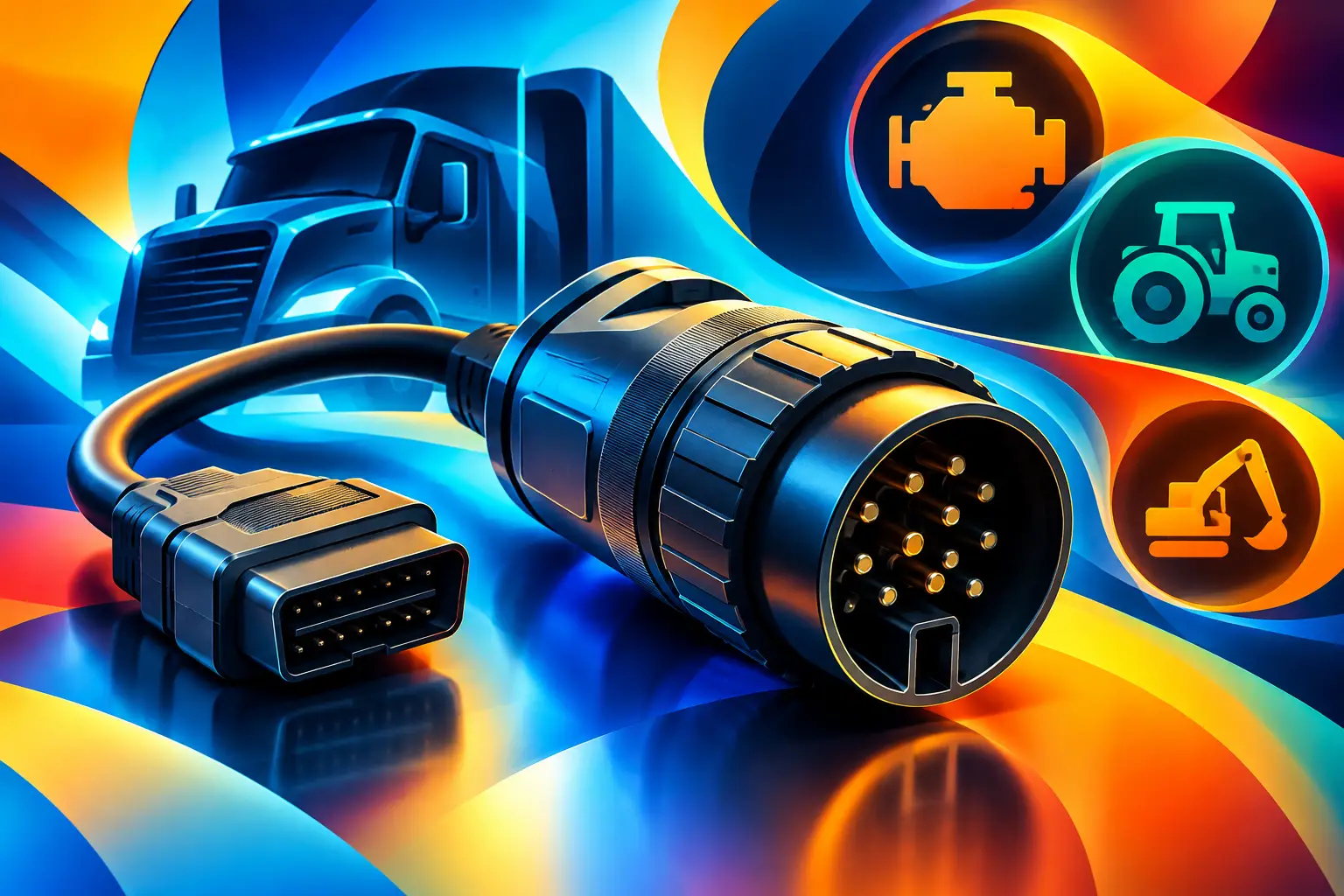
A diagnostic session can fail before the software has even identified the vehicle. On a busy commercial workshop floor, a poor J1939 lead or adapter often looks like a software fault, an ECU fault or a vehicle communications issue. This J1939 adapter review focuses on the points that actually affect day-to-day work: connector fit, pin assignment, CAN stability, supported protocols and whether the hardware is suitable for the lorries your workshop sees.
A J1939 adapter is not simply a physical converter between a diagnostic interface and a vehicle socket. It is part of the communications path between the diagnostic application and multiple control units. If that path is unreliable, fault reading, live data, actuator tests, programming and calibration work can all become slower or impossible.
What a J1939 Adapter Must Do in a Commercial Workshop
SAE J1939 is the common CAN-based communications standard used across heavy-duty vehicles and equipment. In practice, workshops encounter it through the familiar Deutsch 9-pin diagnostic connection, although older vehicle applications may use a 6-pin connection and some equipment requires a manufacturer-specific arrangement.
The adapter must maintain correct communication between the diagnostic interface and the vehicle network. That includes J1939 CAN traffic, but the requirement may extend to J1708/J1587 on older fleets. A workshop using mixed-age vehicles should not assume a modern 9-pin connector alone covers every vehicle that arrives at the door.
For current European lorry work, there is another practical point. Many manufacturer diagnostic platforms depend on specific Vehicle Communication Interfaces, cables and pin arrangements. A generic J1939 adapter may be useful for universal software and basic network access, yet it is not automatically a replacement for the correct brand-specific diagnostic lead. DAF, MAN, Mercedes-Benz, Renault, Scania, Volvo and Iveco applications should always be checked against the software and VCI being used.
J1939 Adapter Review: The Checks That Matter
The best way to assess an adapter is to judge it as workshop hardware rather than as an inexpensive accessory. A low purchase price has little value if the lead loses communication during a forced test or leaves a technician repeating a diagnostic procedure.
Connector quality and retention
Start with the physical connection. A proper 9-pin Deutsch connector should seat firmly, lock positively and release without excessive force. Loose shells, poorly formed pins and weak cable strain relief are common causes of intermittent faults. The issue may only appear when the cable is moved, the cab is vibrating or the diagnostic tool is resting at an awkward angle.
Inspect the moulding around both ends of the lead. The cable should not bend sharply where it enters the connector or interface plug. In a working workshop, cables are pulled around steps, stored in toolboxes and used outdoors. Strain relief is not cosmetic – it protects the internal conductors that carry power and CAN signals.
Where a 6-pin to 9-pin conversion is needed, confirm that the adapter is intended for the protocol and diagnostic system concerned. Physical fit does not prove that the required vehicle data lines are present.
Pin configuration and protocol support
Pinout accuracy is the non-negotiable part of adapter selection. The adapter must route the correct supply, ground and data connections for the intended interface. An incorrect or incomplete configuration can produce no communication, partial module access or unstable readings that waste time during fault finding.
A useful adapter listing should state its connector types, supported protocols and interface compatibility. Vague descriptions such as “works with all lorries” should be treated carefully. Commercial diagnostics is vehicle- and software-dependent. A lead that works well with one universal diagnostic package may not support every function in a manufacturer application.
For workshops covering older vehicles, support for J1708/J1587 can be as relevant as J1939. If the fleet is mainly EURO 5 and EURO 6, verify the exact makes, model ranges and VCI requirements before ordering. The vehicle’s year, engine variant and diagnostic socket type can matter as much as the badge on the grille.
CAN communication stability
A sound adapter should provide stable communication while reading multiple ECUs, viewing live data and carrying out authorised service functions. Repeated disconnects are not acceptable merely because a tool reconnects after a few seconds. They interrupt workflow and can create uncertainty about whether values, fault statuses or test results are current.
CAN stability depends on more than the adapter. Vehicle battery condition, corrosion in the diagnostic socket, damaged vehicle wiring, a poor interface and outdated software can all cause communication failures. That said, a good adapter reduces one major variable. When diagnosing an intermittent network complaint, known-good cables are essential test equipment.
Avoid very long unshielded leads where possible. A short, well-made adapter is generally easier to protect and less likely to be snagged. If extra reach is required, secure the diagnostic equipment rather than allowing the adapter to hang from the vehicle socket.
Compatibility with the diagnostic interface
The adapter and the VCI must be considered as a pair. Some interfaces use a standard 16-pin OBD-style connection on the tool side, while others use proprietary plugs or dedicated leads. Check both ends before purchase, including whether the adapter is intended for direct connection or needs an additional cable.
It is also worth confirming what work you expect to carry out. Reading generic J1939 engine data is one requirement. Accessing manufacturer-specific systems, carrying out guided diagnostics or performing coding and programming functions is another. The latter may require approved or correctly specified equipment, current subscriptions and manufacturer software support.
This distinction matters for fleet and independent workshops alike. Buying a universal adapter to solve every brand-specific task usually creates frustration. A targeted lead for the vehicles you service most often is normally the more efficient purchase.
Practical Testing Before the Adapter Enters Daily Use
A new adapter should be tested on a known-good vehicle before it becomes part of the workshop’s normal diagnostic set. Connect it with the ignition state required by the software, then confirm stable identification, ECU scanning and live-data display. Move the cable gently near each connector while monitoring communications. Any loss of connection suggests a mechanical or internal wiring issue.
Where the software and vehicle support it, check access to more than one ECU rather than stopping after the engine controller appears. This gives a more realistic indication of network communication. Record the adapter alongside the interface and software version that were tested, particularly when several technicians share equipment.
Keep diagnostic leads clean and dry. Dirty pins, moisture and damaged locking collars can turn a dependable adapter into an intermittent fault. Do not force a connector into a socket that does not align correctly. Check the keyway and pin condition first, especially on vehicles that have had previous electrical work.
When a J1939 Adapter Is the Right Purchase
A J1939 adapter is a practical purchase for workshops using compatible universal diagnostic systems, mobile technicians supporting mixed commercial fleets and resellers building complete diagnostic packages. It is also useful as a replacement lead when an existing cable has damaged pins, poor retention or unreliable communication.
It is not the answer to every diagnostic problem. If a particular vehicle requires a manufacturer-specific VCI, a licenced diagnostic platform or a dedicated cable for advanced functions, use the correct equipment. Likewise, an adapter cannot repair a failed CAN network, a weak battery supply or a corroded diagnostic socket.
For workshops dealing with emissions-related faults, diagnostics should be used to identify the actual cause before parts are ordered or repairs are authorised. SCR, AdBlue dosing, NOx sensor and wiring faults can produce related warnings, but the correct repair depends on confirmed fault codes, live values and circuit checks. Proper diagnostic hardware helps establish that evidence quickly.
Buying Decision: Prioritise Fit Over Claims
The strongest buying decision is based on three checks: the vehicle socket, the diagnostic interface connection and the protocols required by the fleet. Once these match, assess build quality and supplier support. Product information should be specific enough to remove doubt before the lead reaches the workshop.
Truckdiag supplies specialist commercial vehicle diagnostic equipment and accessories for workshops that need compatibility-focused hardware. Where there is any uncertainty, confirm the exact lorry make, model, year, engine and diagnostic platform before ordering.
A dependable J1939 adapter should disappear into the job: connect securely, communicate consistently and allow the technician to focus on the vehicle fault rather than the cable in their hand.
