Have Additional Questions? Contact Us →

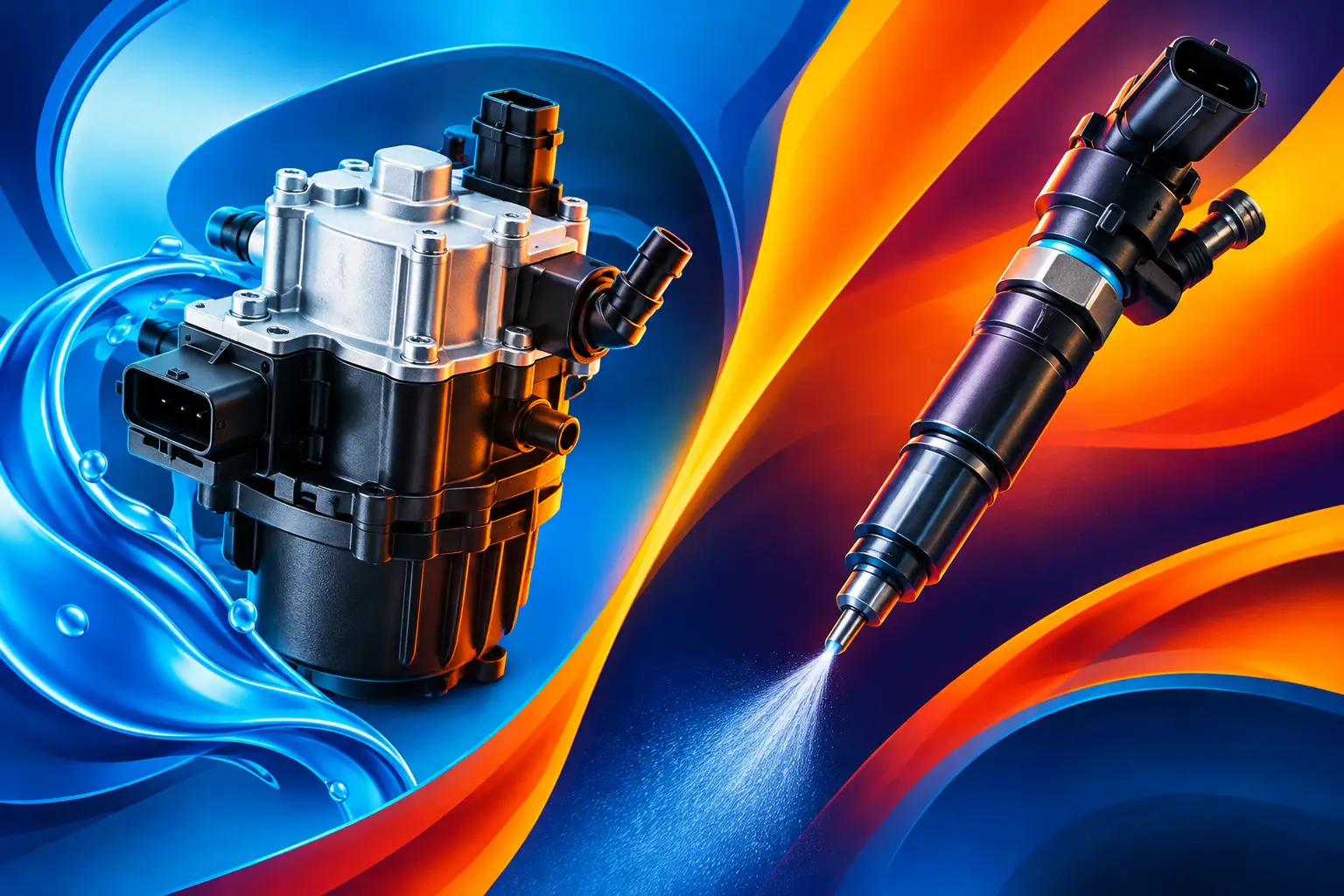
A EURO 6 lorry can display an AdBlue warning, log an SCR efficiency fault and enter torque limitation whether the problem is at the tank or at the exhaust. That is why an AdBlue pump versus injector diagnosis must start with system evidence, not a parts guess. Replacing the wrong component is expensive, wastes workshop time and may leave the vehicle off the road with the same fault still active.
The pump and injector have different jobs, fail in different ways and require different checks. They are also linked by the dosing line, electrical wiring, control unit logic and AdBlue quality. A proper diagnosis separates those elements before a replacement decision is made.
AdBlue pump versus injector: different roles in SCR dosing
The AdBlue pump, often referred to as the supply module or dosing module, draws fluid from the tank and pressurises it for delivery through the line. Depending on the vehicle design, the module may also contain a filter, heater, pressure sensor, temperature sensor or reversing function. That reversing function returns fluid from the line after shut-down, helping to prevent crystallisation and freeze damage.
The injector, also called the dosing valve or dosing nozzle, sits in the exhaust system upstream of the SCR catalyst. It receives a controlled quantity of pressurised AdBlue and atomises it into the exhaust stream. Exhaust heat converts the fluid into ammonia, allowing the SCR catalyst to reduce nitrogen oxide emissions.
In simple terms, the pump provides correctly pressurised AdBlue. The injector delivers it at the correct moment and in the correct spray pattern. Neither component can perform the full dosing function alone. A pump may build pressure but an injector may be blocked. Equally, an injector may be electrically sound while the pump cannot supply sufficient pressure.
What a failing AdBlue pump usually looks like
A pump fault commonly creates a pressure-related issue. The engine control unit commands priming or dosing, but the measured system pressure does not rise, rises too slowly, drops unexpectedly or cannot be relieved correctly after operation.
Typical signs include repeated pressure plausibility codes, a pump motor that does not run during an actuator test, slow priming, a fluid leak around the supply module, or a frozen and damaged tank assembly. On some vehicles, a restricted filter or crystallised pump inlet can mimic a failed pump. Low-quality fluid, contamination and long periods out of use can all contribute.
The workshop should use suitable diagnostic equipment to read both stored faults and live values. Check commanded versus actual dosing pressure during a guided test where the manufacturer procedure permits it. Listen for pump operation, inspect connectors for corrosion or fluid ingress, and test battery supply, ground and control circuits before condemning the module.
AdBlue crystallises when water evaporates. White deposits around the pump connections, tank outlet or line fittings deserve attention, but deposits alone do not prove that the pump has failed. Inspect the full fluid path. A blocked line, leaking coupling or damaged heater circuit can produce similar symptoms.
Pressure is the key distinction
If the system cannot establish or maintain its specified supply pressure, the pump side is the first area to investigate. Exact pressure targets and test sequences vary between DAF, MAN, Iveco, Mercedes-Benz, Scania, Renault and Volvo applications. Use the relevant workshop data rather than applying a figure from another make or engine family.
A replacement supply module may require priming, coding, adaptation or a guided bleed routine. Skipping that process can cause repeat faults even when the new part is correct.
What a failing AdBlue injector usually looks like
Injector faults are more often linked to dosing quality at the exhaust. The valve may be electrically open circuit, shorted, mechanically stuck, contaminated or restricted by crystallised AdBlue. It can also leak after dosing, allowing deposits to build rapidly in the mixer pipe or at the SCR catalyst inlet.
A blocked injector may produce poor NOx conversion despite apparently normal pump pressure. The control unit sees an emissions result that does not match its expected response to dosing. Depending on the manufacturer strategy, this can generate SCR efficiency faults, NOx sensor correlation faults, dosing valve electrical codes or inducement warnings.
Physical inspection is often revealing. Remove the injector only after following the vehicle maker’s safety and cooling procedure, then inspect the nozzle, mounting bore and mixing section for white crystals or abnormal soot accumulation. Do not push wire or drills through the nozzle holes. That can alter the spray pattern and turn a recoverable fault into a replacement requirement.
An injector actuator test can confirm whether the control unit is able to energise the valve, but it does not prove that atomisation is correct. Where the approved diagnostic procedure supports it, assess electrical resistance, wiring continuity and the response of the system during a measured dosing test. Any escaped fluid must be handled correctly, and exhaust components can remain dangerously hot after operation.
A clean injector does not always mean a good injector
An injector can look clean and still fail electrically or stick internally. Conversely, heavy crystallisation around the nozzle may be caused by poor line purging, an exhaust temperature issue, an incorrectly seated injector, a damaged seal or an upstream pressure fault. The injector is often where the deposit is visible, but it is not always where the fault began.
Why the fault codes alone are not enough
SCR systems calculate performance from several inputs. NOx sensors, exhaust temperature sensors, tank temperature, level readings, pump pressure, dosing commands and catalyst models all influence the final judgement. A fault code pointing to low conversion does not automatically mean the injector is defective.
For example, a lorry with a weak pump may dose intermittently. The eventual fault may appear as low SCR efficiency. A dosing injector with a poor spray pattern can create the same efficiency complaint, as can contaminated AdBlue, an inaccurate NOx sensor, exhaust leakage upstream of the sensors or a catalyst that has suffered prolonged contamination.
This is why a sensible diagnostic order matters. Start by recording all fault codes and freeze-frame information. Confirm fluid level, condition and correct specification. Inspect for leaks, damage and crystal deposits. Then use live data and guided actuator tests to establish whether the system is building pressure, commanding the injector and achieving a believable NOx response.
Do not clear codes repeatedly in the hope that the warning will stay off. Fault history and operating conditions are valuable evidence. Clearing them before recording data can make a difficult SCR diagnosis slower.
A practical workshop decision process
When deciding between an AdBlue pump and injector, separate the job into supply, delivery and result. Supply means the tank module can draw and pressurise fluid. Delivery means the line and injector can transfer and atomise that fluid. Result means the NOx sensors and SCR catalyst show the expected reduction once dosing takes place.
If supply pressure is absent or unstable, investigate the pump module, its power supply, connectors, filter, heater and line integrity. If pressure is within specification but dosing output or spray quality is suspect, inspect and test the injector circuit and nozzle. If both elements pass their direct tests but SCR performance remains poor, extend diagnosis to fluid quality, sensors, exhaust leaks, mixer condition and catalyst health.
This approach is more reliable than replacing the most accessible part. It also protects the customer from unnecessary cost and reduces the chance of a comeback after an apparently successful repair.
Parts selection and installation checks
Commercial vehicle SCR parts are not universal. A similar-looking injector or pump may have different connectors, calibration, plumbing orientation or software requirements. Confirm the vehicle identification, engine variant, EURO standard and original equipment number before ordering. Special applications, including particular DAF LF and high-output Scania variants, may use different arrangements from the main model range.
Before fitting a replacement component, clean the surrounding area and inspect seals, fittings and wiring. Use fresh, correctly specified AdBlue from a clean container. After installation, complete any manufacturer-required priming, leak check, adaptation and road-test routine. Finally, verify that pressure, dosing activity and NOx readings behave correctly under the conditions required for monitor completion.
SCR faults should be repaired in a way that preserves the vehicle’s approved emissions operation and legal roadworthiness. A tested, compatible component and a disciplined diagnostic process will usually save more time than a quick parts swap – especially when the next load is waiting.
