Have Additional Questions? Contact Us →

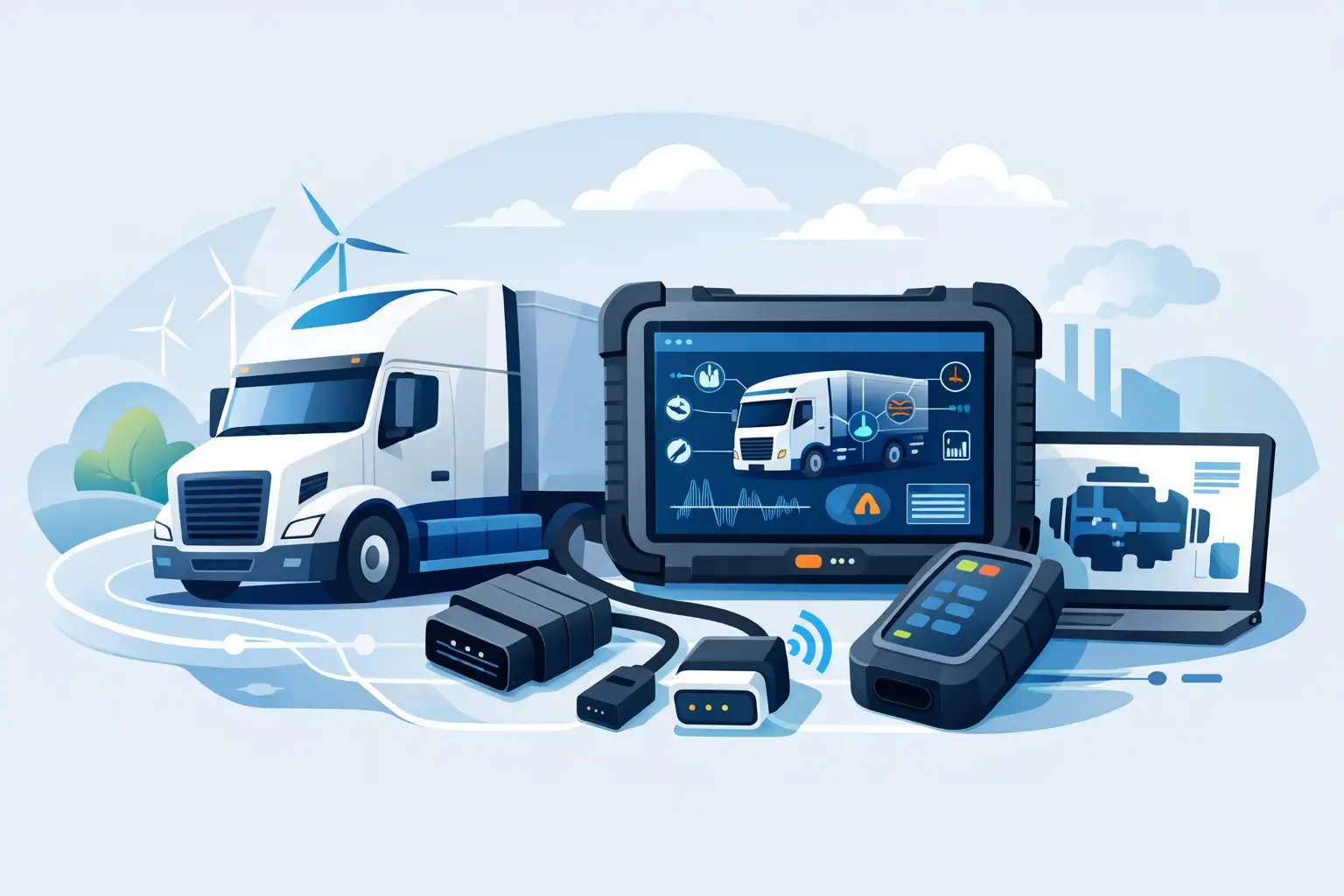
A EURO 6 lorry with an AdBlue warning, torque reduction or intermittent engine fault does not need guesswork. The best EURO 6 diagnostic interfaces give a workshop access to the right control units, live data and guided tests before a vehicle loses another working day. For fleet maintenance teams and independent commercial workshops, the correct interface is not simply the one with the longest vehicle list. It is the one that can communicate properly with the vehicles you actually service.
EURO 6 diagnostics are more demanding than a basic fault-code read. Modern DAF, MAN, Mercedes-Benz, Scania, Renault, Volvo and Iveco vehicles can have multiple interconnected controllers for engine management, SCR, EGR, transmission, brake systems, body electronics and telematics. A low-cost universal reader may display a generic code, but it often cannot identify the operating conditions that caused it, run actuator tests or carry out the required calibration after repair.
What Makes the Best EURO 6 Diagnostic Interfaces?
The first requirement is commercial vehicle coverage at system level. An interface should enter the engine ECU, ACM or SCR controller, transmission, ABS/EBS, instrument cluster and body modules where supported. Generic OBD access is useful for a quick first check, but it is not enough for professional fault-finding on a modern lorry.
Protocol support matters just as much. EURO 6 vehicles commonly use J1939 CAN communication, while newer models may introduce CAN FD, DoIP or manufacturer-specific security functions. If the workshop sees late-model vehicles, buy for the vehicles arriving next year as well as those already in the yard. An interface that cannot handle newer communication standards can become a costly limitation surprisingly quickly.
Live data quality separates a workshop tool from a basic reader. For emissions-system diagnosis, technicians need more than a stored DTC. They need to compare NOx sensor values, exhaust temperatures, differential pressure, AdBlue pressure, dosing activity, calculated soot load and SCR conversion performance. The ability to graph values, record a road test and compare commanded values with actual values makes intermittent faults far easier to isolate.
The final factor is the software platform behind the hardware. A diagnostic interface is only as capable as its current software licence, vehicle database and technical functions. Check whether updates are included, whether the licence covers heavy-duty vehicles rather than passenger cars, and whether advanced functions require extra payment. A lower purchase price can be false economy if annual renewal costs or missing software modules prevent the tool being used when needed.
Interface Types for EURO 6 Workshops
There is no single best choice for every commercial workshop. The right platform depends on vehicle mix, expected repair work and whether the business needs dealer-level functions or broad multi-make coverage.
Multi-make commercial diagnostic platforms
For workshops servicing several marques, a dedicated commercial multi-make platform is usually the most practical starting point. Systems from established heavy-vehicle diagnostic suppliers can provide guided diagnostics, wiring information, technical data, service functions and wide coverage across European lorries, trailers and often light commercial vehicles.
This type of interface suits a workshop working on DAF one day, Volvo the next and a mixed fleet of MAN, Scania and Renault vehicles later in the week. It reduces the need for separate tools, gives technicians a familiar workflow and supports a faster initial diagnosis. The compromise is that coverage can vary by model year and function. A multi-make tool may read and clear faults very well while offering fewer configuration or security functions than the manufacturer system.
Manufacturer-specific interfaces
A manufacturer-specific interface is the stronger option where one marque dominates the workload. A Scania-focused workshop, for example, may need deeper access than a general platform can provide. The same applies to workshops specialising in Mercedes-Benz, Volvo, Renault, DAF, MAN or Iveco vehicles.
These interfaces are typically better for software updates, controller replacement procedures, parameterisation and marque-specific test routines. They can also be essential when a repair requires exact factory workflow rather than general diagnostics. Their limitation is obvious: each additional marque can mean extra hardware, software subscriptions and technician training.
PC-based interfaces versus tablet systems
PC-based interfaces remain popular in established workshops because they can offer detailed information, larger screens and easier report management. They are well suited to technicians who work at a bench, use manufacturer software or need to retain diagnostic records for fleet customers.
Tablet-based systems are quicker to deploy around the vehicle and useful for road tests, inspections and mobile call-outs. However, check battery life, wireless stability and whether the tool still performs key functions with poor internet coverage. A tablet is convenient, but a workshop should not rely on a cloud connection for every job.
Pass-through and programming-capable tools
Where ECU programming, coding or configuration is part of the service offer, a pass-through-capable interface may be necessary. These tools can provide the communication link required by approved software, but compatibility must be checked carefully. Programming is not a feature to assume from a fault-code reader.
Voltage stability is also critical. Before any programming work, use a suitable stabilised power supply and follow the vehicle maker’s procedure. A lost connection or low battery voltage during a flash operation can turn a routine repair into an ECU recovery job.
Checks Before You Buy
Start with a realistic list of vehicles, not a list of desirable features. Record the marques, model years and common work entering the workshop. Include tractors, rigids, municipal vehicles, vans if relevant, trailers and any specialist variants such as DAF LF or high-specification Scania models. Then ask the supplier to confirm coverage for those vehicles and functions.
Do not accept a simple statement that a tool supports EURO 6. EURO 6 is an emissions classification, not a guarantee of diagnostic capability. Ask whether the interface can access the required control modules, read manufacturer codes, display live data, perform actuator tests, reset service functions and support coding where needed. These are separate functions, and the answer can differ between vehicle generations.
Also check the supplied connection leads. Heavy-duty diagnostic work may require a 16-pin OBD lead, 9-pin Deutsch connector, older round connectors or brand-specific cables. The interface may be capable, but the job stops if the correct cable is not in the case. For mobile technicians, a protected case with clearly labelled leads saves time and prevents damaged connectors.
Subscription terms deserve close attention. Confirm the first-year software entitlement, renewal price, update frequency and what happens when a subscription expires. Some tools continue to operate with existing coverage but receive no new vehicles or functions. Others restrict access more heavily. There is no universal right answer, but the operating cost should be clear before purchase.
Finally, consider technical support. A fault code can be read in seconds; interpreting a conflicting set of NOx, temperature and dosing values takes experience. A specialist supplier that can clarify compatibility before purchase and provide product guidance by email has practical value when a vehicle is occupying a bay.
A Practical Selection Route
A mixed independent workshop should normally prioritise a professional multi-make commercial interface with current EURO 6 coverage, guided diagnostics and reliable live-data capability. It will handle the widest day-to-day workload and provide a sound return where several brands are serviced.
A fleet operating mainly one make should compare that broad platform with the relevant manufacturer system. The multi-make tool may cover routine repairs efficiently, while the marque-specific system can be justified for deeper configuration, programming and difficult faults. Larger fleets often need both rather than treating them as alternatives.
For emissions-related jobs, choose an interface that lets the technician see the complete operating picture. Reading an SCR code without checking temperature conditions, sensor plausibility, pressure values and the system’s commanded activity can lead to unnecessary parts replacement. The aim is to establish whether the fault is electrical, mechanical, contamination-related, software-related or caused by another engine condition affecting SCR operation.
Truckdiag supplies specialist diagnostic equipment for commercial vehicle applications, where compatibility and function matter more than generic claims. Before ordering, match the interface to the exact lorry range and the work your technicians need to complete.
The best purchase is the interface that shortens diagnosis without creating a new limitation at the next vehicle. Confirm the coverage, software terms, cables and support first, then put the tool to work where it earns its place: getting a compliant, properly repaired lorry back into service.
