Have Additional Questions? Contact Us →

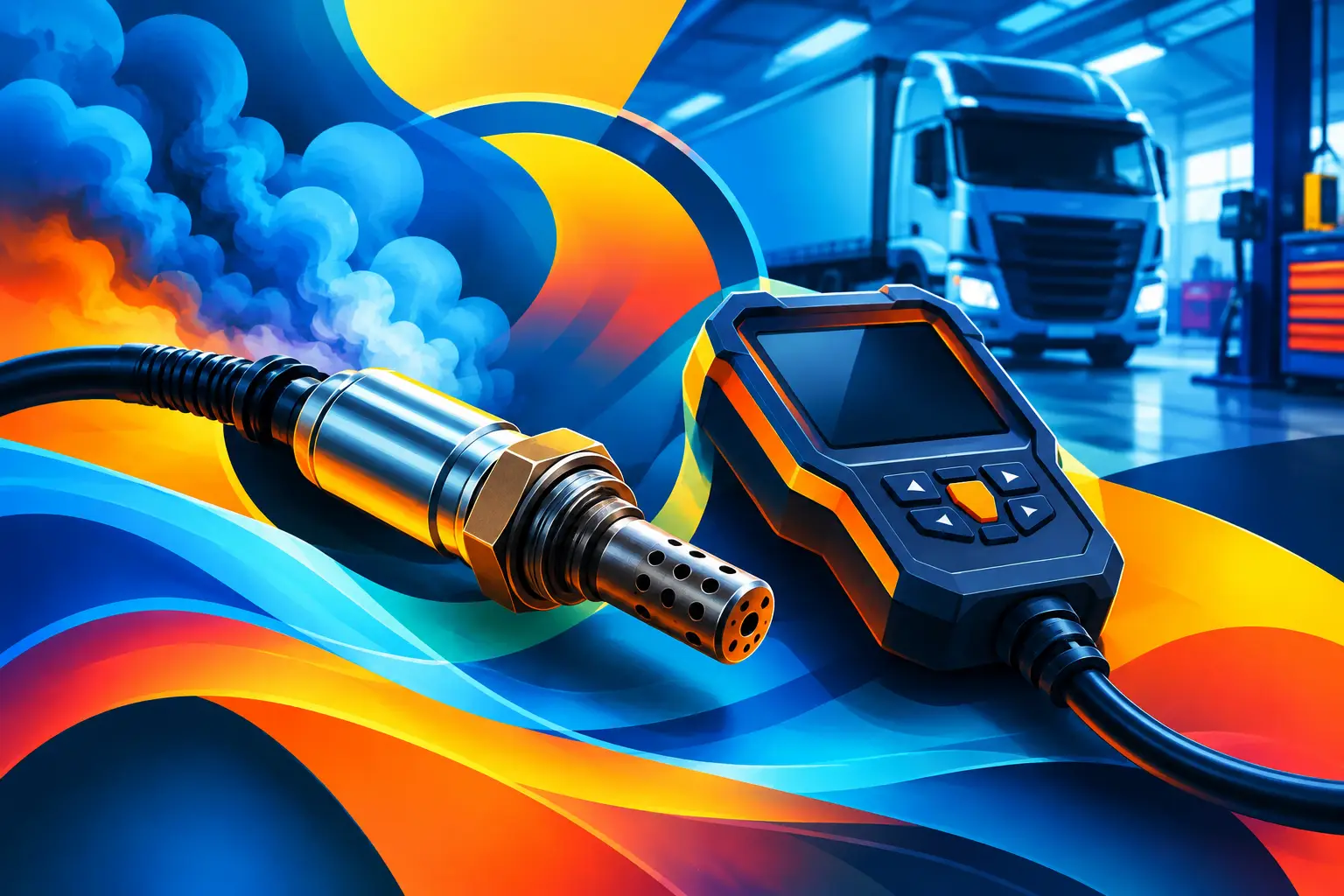
A Euro 6 lorry can arrive with an amber engine lamp, AdBlue warning and a derate countdown, yet the stored NOx fault may not mean the NOx sensor itself has failed. The best NOx sensor testers help a workshop separate a genuinely defective sensor from wiring faults, poor exhaust conditions, SCR efficiency problems and ECU communication issues before expensive parts are fitted.
For commercial workshops, a useful tester is rarely a single-purpose handheld meter. It is usually a lorry-capable diagnostic platform that can access the engine ECU, read live values, run guided tests and identify the exact sensor position. That matters because modern NOx sensors are intelligent modules, with their own control electronics, heaters and CAN communication.
What makes the best NOx sensor testers?
The right tool depends on the vehicles on your ramp, but diagnostic coverage is the first requirement. A generic OBD reader may display a powertrain fault code, but it often cannot provide the manufacturer-specific data needed to prove the cause. On DAF, MAN, Iveco, Mercedes-Benz, Scania, Renault and Volvo vehicles, access to the correct engine system and fault-code definition saves time at the first inspection.
A workshop-grade NOx diagnostic tool should show live upstream and downstream NOx readings, exhaust temperatures, SCR-related values, AdBlue dosing status and relevant supply voltages. It should also identify whether the issue relates to sensor signal plausibility, heater control, internal sensor electronics or CAN communication. Reading only a code such as a NOx sensor circuit fault is not enough to make a replacement decision.
Guided tests are equally valuable. These tests can prompt the technician to check conditions that affect the result, such as engine temperature, exhaust temperature, urea quality, reductant pressure or dosing operation. They reduce guesswork, particularly where an intermittent fault has been logged after a long motorway run rather than while the vehicle is cold in the workshop.
Why a multimeter is not a complete NOx sensor tester
A digital multimeter remains essential for checking powers, grounds, continuity and connector condition. It can identify corroded terminals, damaged loom sections, voltage-drop issues and poor earth connections. These checks should be completed before condemning a costly sensor.
However, a multimeter cannot confirm that a smart NOx sensor is measuring emissions accurately or communicating correctly with the ECU. Most Euro 5 and Euro 6 NOx sensors incorporate a controller and communicate digitally. The sensor’s output is not a simple analogue voltage that can be validated with a basic probe measurement.
An oscilloscope can be useful where a workshop needs to investigate CAN wiring integrity, interference or intermittent communication. It is a strong supporting tool, especially for vehicle electronics specialists, but it is not a replacement for diagnostic software with correct commercial vehicle coverage. The practical combination is a capable lorry diagnostic tester, a quality multimeter and, where required, an oscilloscope.
The diagnostic functions worth paying for
When comparing testers, focus on the functions that shorten fault-finding time rather than the longest list of vehicle makes. A tool must cover the commercial vehicles you actually service and provide enough depth in their engine and emissions systems.
Live data is the key feature. The technician needs to compare upstream and downstream NOx values once the exhaust system is hot and operating in suitable conditions. The downstream value should respond to effective SCR dosing and conversion. If both readings are implausible, frozen or inconsistent with other system data, the fault may be sensor-related, but the wider system still needs checking.
Look for a tester that gives access to fault-code status as well as the code itself. Current, pending, stored and intermittent faults tell different stories. Freeze-frame data can show coolant temperature, engine load, road speed and other conditions when the fault occurred. This is particularly useful when a fleet operator reports that a warning only appears under load or on longer routes.
Bidirectional controls and actuator tests add another level of workshop value. Depending on make and model, these may allow checks of dosing components, heater circuits, SCR functions and reset or adaptation procedures after authorised repair. The exact menu varies by vehicle, so confirmed coverage for the lorry brand and engine family is more useful than a broad marketing claim.
Service information is also a practical buying factor. Pin-out data, wiring diagrams, guided fault trees and manufacturer code descriptions can prevent unnecessary disassembly. A diagnostic platform without technical information may still read data, but it leaves the technician searching for the next test.
Match coverage to the fleet, not the box label
A tester advertised for heavy-duty diagnostics is not automatically suitable for every vehicle in a mixed fleet. Before buying, check coverage against the actual models, model years and engine systems in the workshop. A tool may support basic diagnostics on one brand while providing full engine, aftertreatment and special-function access on another.
For an independent workshop servicing several European makes, multi-brand coverage is usually the most commercial choice. It allows one platform to deal with DAF, MAN, Iveco, Mercedes-Benz, Scania, Renault and Volvo work, while reducing training and subscription complexity. The trade-off is that manufacturer-level functions may vary between brands and software packages.
For a fleet focused on one manufacturer, an OE-level or brand-led system can be the better investment. It may provide deeper guided diagnostics, more detailed technical descriptions and better access to coding or replacement procedures. The downside is cost and reduced usefulness when an outside vehicle comes onto the ramp.
Resellers and specialist electronics businesses should also consider update policy, licensing and support. NOx and SCR systems change across emissions generations, and software coverage that is current today can lose value quickly if updates are unclear or expensive. Confirm what is included, how often the database is updated and whether support can help with a coverage question before purchase.
A sensible NOx sensor test process
Start with a full vehicle scan, not the engine ECU alone. SCR and NOx faults can be influenced by related systems, and other stored codes may point to the root cause. Record all codes, their status and freeze-frame information before clearing anything.
Next, inspect the basics. Check the sensor connector for water ingress, heat damage, stretched wiring and terminal corrosion. Follow the harness where it passes close to the exhaust, chassis brackets and heat shields. Check battery condition and charging voltage too, as low system voltage can produce misleading electronic faults.
Once the engine and exhaust are at operating temperature, use live data to assess the upstream and downstream sensor values alongside exhaust temperature and SCR operating status. Do not expect meaningful NOx readings from a cold exhaust or during a short idle period. Road testing, a controlled loaded test or the manufacturer’s guided routine may be necessary.
If data suggests an SCR performance issue, test the system rather than replacing the downstream sensor on assumption. Inspect for exhaust leaks, incorrect or contaminated AdBlue, dosing faults, crystallisation, poor temperature conditions and catalyst efficiency problems. An upstream sensor fault can also affect how the ECU judges downstream conversion.
Only replace a NOx sensor when fault codes, wiring checks and live data support that decision. After replacement, carry out any required reset, adaptation or confirmation procedure with the diagnostic tester. Then verify the repair with a complete rescan and a proper drive cycle where required.
Common buying mistakes
The cheapest code reader is often a false economy in a commercial workshop. It may identify a generic code but leave the technician unable to see sensor values, perform tests or complete post-repair procedures. That can turn a straightforward diagnosis into repeated parts fitting and vehicle downtime.
Another mistake is treating all NOx sensor faults as identical. Upstream and downstream sensors have different roles, and their expected readings depend on operating conditions. A tester needs clear data labels and enough system context to avoid comparing the wrong values.
Finally, do not overlook hardware practicality. Workshops need a durable interface, reliable vehicle communication, a readable screen or dependable laptop connection, and software that is straightforward to use under time pressure. Fast access to compatible tools and expert guidance about products via email can be as useful as one additional menu function when a lorry is occupying a bay.
The best purchase is the tester that lets your workshop prove the fault before replacing parts, supports the lorries you see every week and remains useful as Euro 6 diagnostic work becomes more demanding.
