Have Additional Questions? Contact Us →

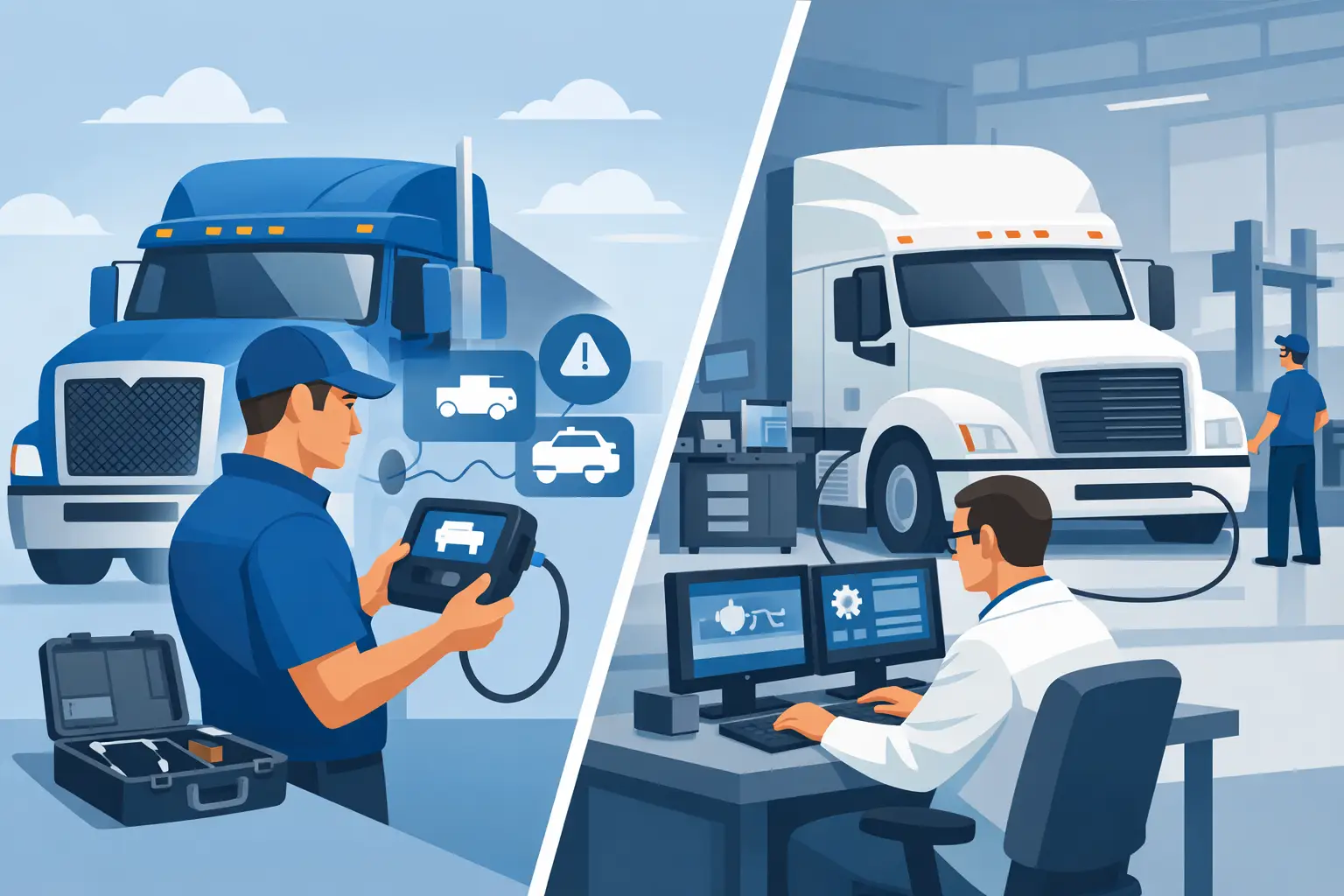
A lorry arrives with an SCR warning, reduced torque and a driver waiting for an answer. The lorry scanner vs dealer diagnostics decision matters at that point because reading a fault code is only the first part of the job. The real question is whether the tool can identify the failed component, check live values, run the required test and return the vehicle to service without unnecessary parts replacement.
For independent workshops and fleet maintenance teams, a quality multi-brand scanner is often the most practical first-line tool. Dealer-level diagnostics remain necessary for certain programming, security and manufacturer-specific procedures. The strongest workshops understand where each option performs well and avoid treating either one as a complete replacement for the other.
What a commercial vehicle scanner can do
A professional heavy-duty lorry scanner is designed to work across multiple makes from one interface. Depending on the tool and licence package, it can communicate with systems on DAF, MAN, Iveco, Mercedes-Benz, Scania, Renault and Volvo vehicles, alongside other commercial vehicle brands.
For routine diagnostic work, this can cover a substantial part of the workshop workload. A capable scanner reads and clears fault codes, displays live data, identifies ECU information, records fault histories and can perform active tests on selected components. On an EURO 5 or EURO 6 lorry, that may include checking NOx sensor readings, AdBlue dosing values, exhaust temperatures, differential pressure, battery voltage and CAN communication status.
This is where a multi-brand tool earns its place. A workshop servicing mixed fleets does not need separate factory hardware on the bench every time it receives a different badge. One system can provide a consistent workflow for the technician, reduce equipment cost and speed up initial assessment.
The limitation is depth. Scanner coverage is never identical across every manufacturer, model year and control unit. A function available on one Volvo platform may not be available on a newer Scania or a specialist DAF LF configuration. Before buying, compatibility must be checked against the actual vehicle range, not simply the manufacturer name on the tool listing.
Where scanners are strongest
A lorry scanner is usually the right choice for general fault-finding, pre-purchase inspections, scheduled fleet checks and day-to-day service work. It is particularly useful when a workshop needs to establish whether a warning is caused by a sensor fault, wiring problem, low system pressure, dosing issue or a communication failure.
It also gives technicians useful evidence before further work begins. Live data can show whether a reported fault is current, intermittent or historical. Comparing commanded and actual values helps prevent the familiar mistake of replacing a part because its code is present, rather than proving that the part has failed.
For mobile technicians, multi-brand diagnostics are also more practical than carrying a separate laptop, interface and subscription arrangement for every marque. The time saved at the roadside or in a fleet yard can be significant.
Lorry scanner vs dealer diagnostics: the practical difference
Dealer diagnostics are built around one manufacturer’s vehicles. They normally provide the deepest access to that brand’s control units, repair procedures, software updates, guided functions and technical documentation. In many cases, they are the only approved route for protected programming and factory-level calibration.
This does not mean dealer equipment is automatically better for every repair. It means it is more specific. If the vehicle is a current-generation Mercedes-Benz Actros with a control unit requiring authorised software programming, dealer-level access may be the correct route. If the workshop is checking multiple older EURO 6 fleet vehicles for stored SCR faults and live sensor values, a good commercial scanner may complete the job faster and at lower operating cost.
The difference is best understood as breadth versus depth. A multi-brand scanner provides broad coverage across the workshop. Dealer diagnostics go deeper into one manufacturer’s systems.
Dealer platforms may also require ongoing subscriptions, approved interfaces, online access, user credentials and training. These costs can be justified for a specialist workshop working on one make every day. They are harder to justify for a general commercial workshop that sees a broad mix of lorries each week.
Functions that may require dealer-level access
Modern commercial vehicles increasingly use secure gateways and protected diagnostic functions. A scanner may communicate with the vehicle and retrieve faults while still being restricted from writing data or entering certain control-unit functions.
Dealer diagnostics, or an approved manufacturer-supported alternative, may be needed for software flashing, ECU replacement configuration, security-related coding, advanced parameterisation and certain guided calibration routines. The exact requirement depends on the manufacturer, vehicle age and system involved.
This is especially relevant after replacing electronic components. Fitting a new module is not always the end of the repair. The vehicle may require configuration data, an immobiliser or security procedure, injector coding, clutch calibration or a software update before it operates correctly.
A professional workshop should therefore distinguish between a scan tool that can diagnose a problem and a platform that can complete every factory procedure. Promising full dealer capability from a generic device is rarely realistic.
SCR and AdBlue faults need more than code clearing
SCR faults are a common source of downtime on EURO 5 and EURO 6 commercial vehicles. A dashboard warning may point to AdBlue quality, dosing pressure, a NOx sensor, a temperature sensor, a blocked line, a wiring issue or an internal ECU fault. Several of these conditions can produce similar symptoms, including reduced power or a start restriction countdown.
Clearing the code without resolving the cause usually returns the vehicle to the same position, often with less time available to repair it. The correct approach is to read all related codes, inspect freeze-frame data where available, review live values and test the relevant circuits and components.
A suitable scanner can make this process efficient by showing whether temperature readings are credible, whether the pressure system is building correctly and whether sensor signals agree with operating conditions. For difficult cases, manufacturer test plans and wiring information may be required to isolate the fault properly.
Emissions controls should be repaired and maintained in line with applicable roadworthiness, environmental and manufacturer requirements. Diagnostic equipment is most valuable when it helps the workshop restore correct operation, document the repair and prevent a repeat failure.
Choosing the right tool for the workshop
The right buying decision depends on the jobs entering the workshop, not on the longest feature list. A fleet workshop maintaining several makes will generally benefit from broad multi-brand coverage, regular updates and straightforward access to common service functions. A specialist working mainly on one manufacturer may gain more from the deeper functions available through that brand’s diagnostic platform.
Before purchasing, check the supported vehicle list by model, year and system. Ask whether the package includes heavy-duty vehicles rather than passenger cars only, whether licences are time-limited, and which service functions are supported for the makes you repair. Also check whether the tool supports live data graphs, active tests, report generation and fault-code interpretation. Those functions affect repair speed far more than a basic read-and-clear capability.
Hardware quality matters as well. A reliable interface, stable communication and current software are essential when working around commercial vehicle control units. Cheap tools with unclear update arrangements can cost more in lost time than they save at purchase.
Technical support has a practical value too. When a tool will not connect to a particular vehicle or a function is missing, a supplier that understands commercial diagnostics can help establish whether the issue is vehicle compatibility, a software setting, a cable requirement or an access restriction. Truckdiag supplies specialist equipment for commercial vehicle electronics and diagnostics, where compatibility accuracy is central to the purchase.
A sensible diagnostic workflow
Start with the vehicle condition, driver report and warning messages before connecting any tool. Check battery condition, obvious wiring damage, fluid levels and connector corrosion, particularly around exhaust after-treatment components exposed to heat, water and road contamination.
Then perform a full-system scan rather than reading only the ECU named by the dashboard warning. Network faults can create secondary codes across several control units. Record the codes and live data before clearing anything, then repair the confirmed fault and verify the result with a road test or relevant stationary test.
If the scanner reaches its limit, do not force the process. Move to dealer-level diagnostics, authorised programming support or the manufacturer procedure when the repair requires it. That decision protects the vehicle, the workshop and the customer’s operating time.
The best setup is rarely scanner or dealer diagnostics alone. It is a dependable multi-brand tool for fast, profitable daily work, backed by a clear route to deeper manufacturer access when the vehicle demands it. Choose the equipment around the fleet you actually service, and every diagnostic session starts with a better chance of getting the lorry back on the road properly.
