Have Additional Questions? Contact Us →

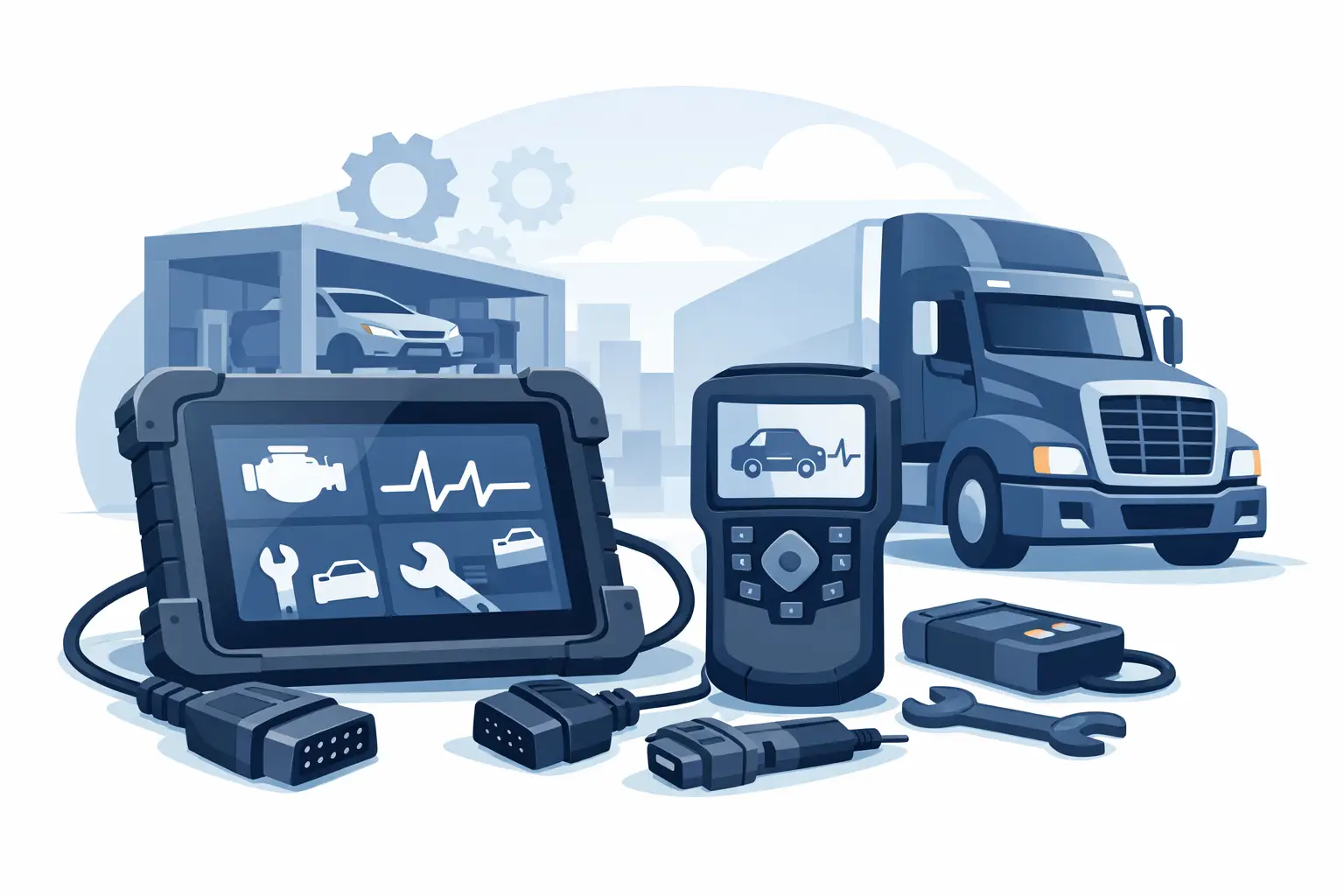
A heavy duty diagnostic tool earns its place the first time it saves a lorry from an unnecessary parts swap, a missed delivery slot, or a second visit to the bay. In a commercial workshop, that is the real test. It is not about flashy menus or long feature lists. It is about getting accurate fault data, reaching the right control unit, and doing the job fast enough to keep vehicles moving.
For fleet workshops, independent mechanics, and diagnostic resellers, buying the wrong platform is expensive in a way that goes beyond the purchase price. Limited brand coverage, poor communication with EURO 5 and EURO 6 systems, or weak software support can leave a tool sitting on the shelf while the harder jobs still need outside help. That is why selection needs to be based on actual workshop use, not broad claims.
What a heavy duty diagnostic tool should actually do
At the basic level, any heavy duty diagnostic tool should read and clear fault codes, show live data, and identify control units. That is only the starting point. On modern lorries, useful diagnostics also means access to engine, gearbox, braking, suspension, body, emissions, and aftertreatment systems without guesswork or patchy communication.
A workshop-grade tool should also support service functions and guided testing where available. That includes injector coding, DPF and SCR related procedures, sensor checks, actuator tests, calibrations, and maintenance resets. If you regularly deal with AdBlue faults, NOx sensor problems, derate conditions, or intermittent CAN issues, basic code reading is nowhere near enough.
This is where many buyers get caught out. A tool may technically support a brand, but only at a shallow level. It might connect to the engine ECU yet fail to access aftertreatment modules properly, or it may offer live data without the bi-directional control needed to prove whether a component is faulty. Coverage depth matters more than a long list of logos on the box.
Coverage matters more than marketing
If your workshop sees DAF, MAN, Iveco, Mercedes-Benz, Scania, Renault and Volvo every week, brand coverage needs to be checked model by model and system by system. A diagnostic platform that performs well on one manufacturer may be weaker on another, especially on newer EURO 6 vehicles with more complex emissions architecture.
The right choice depends on your workload. A fleet with mostly one make may be better served by a more focused solution with stronger brand-specific functions. An independent commercial workshop usually needs broader multi-brand coverage, even if that means accepting that certain advanced functions vary between manufacturers.
There is also the issue of special variants and less common models. If you handle vehicles such as DAF LF series, high-output Scania units, or mixed-age municipal and contractor fleets, compatibility should never be assumed. It needs checking in advance. This is where a specialist supplier is more useful than a generic automotive seller. Truckdiag, for example, works in a market where buyers care about exact fit, exact function, and whether a tool will deal with a known platform-specific fault path.
Software quality decides whether the tool is profitable
Hardware gets attention because it is easy to compare. Software is what determines whether the tool makes money. Slow navigation, poor translations, unstable communication, and confusing parameter names all cost time at the vehicle. In a busy workshop, ten wasted minutes on each diagnostic session adds up quickly.
A good platform presents fault information clearly, structures systems in a logical order, and gives reliable live data. It should also keep software updates coming. Lorry electronics do not stand still, and neither do fault strategies, control units, or service procedures. If the update policy is unclear, or support drops away after sale, the value of the tool drops with it.
There is a trade-off here. Some lower-cost units can be useful for occasional work, especially if the job is mainly fault reading and basic service resets. For workshops taking on electronic diagnostics daily, cheap software usually becomes expensive very quickly. Intermittent connection, missing functions, and poor support are not minor inconveniences when a vehicle is off road.
Why emissions and aftertreatment functions are a key test
For many commercial vehicle workshops, emissions faults are where a heavy duty diagnostic tool proves whether it is fit for purpose. EURO 5 and EURO 6 systems create some of the most time-sensitive and revenue-critical jobs in the bay. SCR faults, AdBlue dosing issues, DPF loading, NOx sensor errors, and engine power limitation all need clear diagnostic access.
The tool should let you read the full picture, not just a surface-level code. You need to see relevant live values, trigger tests where supported, and confirm whether the issue sits with a sensor, pump, wiring fault, control strategy, or a wider system condition. If it cannot do that, you are left working around the tool instead of with it.
This matters even more if your business also handles electronic intervention products, coding equipment, or specialist emissions-related hardware. Diagnostic accuracy is the foundation. Before any programming, replacement, or advanced intervention is considered, the fault path has to be understood correctly.
Build quality and workshop practicality
A heavy duty diagnostic tool is used in a workshop, not a showroom. It needs to tolerate rough handling, repeated cable use, dirty environments, and long days. That means connectors that fit properly, interfaces that stay connected, and a unit that does not become unreliable after regular transport between jobs.
Usability matters just as much. If technicians need three screens to reach a common test, they will avoid the tool when the day gets busy. Fast start-up, clear menus, and sensible workflow are not luxuries. They directly affect labour time and technician confidence.
Portable tablet-based systems can be convenient, especially for roadside or yard work, but there is always a balance between convenience and durability. A workshop PC-based setup may offer better screen space and longer-term comfort for detailed work, while a handheld system may be easier for quick inspections. The best fit depends on how and where diagnostics are actually carried out in your operation.
Support, updates and stock availability
For professional buyers, support after purchase is part of the product. If activation becomes difficult, if software needs updating, or if a compatibility question comes up on a specific lorry, quick answers matter. Expert guidance by email is not just a nice extra in this sector. It helps reduce downtime and avoids buying the wrong equipment.
The same applies to stock and delivery. When a workshop needs a tool, it usually needs it for a live issue, not a future idea. Fast shipping and clear availability have real commercial value. So do secure payment and a straightforward returns policy. These are practical trust signals, especially for resellers and repair businesses that cannot afford delays.
Buying for your workshop, not for an ideal workshop
The best buying decision starts with honest workload analysis. If most of your jobs involve routine servicing and occasional diagnostics across several brands, you may not need the most advanced platform on the market. If your workshop is regularly dealing with electrical faults, aftertreatment problems, coding, and module communication issues, entry-level equipment will hold you back.
Think about technician skill as well. A powerful platform in the hands of an experienced diagnostic specialist can be a strong investment. The same tool may be underused in a workshop that mainly needs fast fault confirmation and service functions. The right answer is not always the most expensive unit. It is the one that matches your jobs, your staff, and the brands coming through the door.
Resellers should take the same view. Customers buying in the heavy vehicle sector are rarely looking for novelty. They want compatibility, repeatable results, and a supplier who understands what the tool is supposed to do on a real vehicle.
What separates a specialist supplier from a generic one
In this market, broad automotive sellers often struggle with the details that matter most. They may list a product as suitable for heavy vehicles without clarifying coverage depth, software scope, or brand-specific limits. That creates risk for the buyer and usually leads to delays, returns, or disappointment.
A specialist supplier is more likely to understand why a workshop asks about SCR procedures on a particular EURO 6 model, or whether a unit will support coding functions on one make but not another. That level of product relevance saves time before the order is placed and reduces expensive mistakes after delivery.
If your work depends on accurate diagnostics, buying from a supplier that knows commercial vehicle electronics is usually the safer route. The tool itself matters, but so does the quality of the information behind it.
A heavy duty diagnostic tool should make difficult jobs clearer, not more complicated. Choose the platform that fits the vehicles you actually service, the faults you actually see, and the level of support you expect when the pressure is on.
