Have Additional Questions? Contact Us →

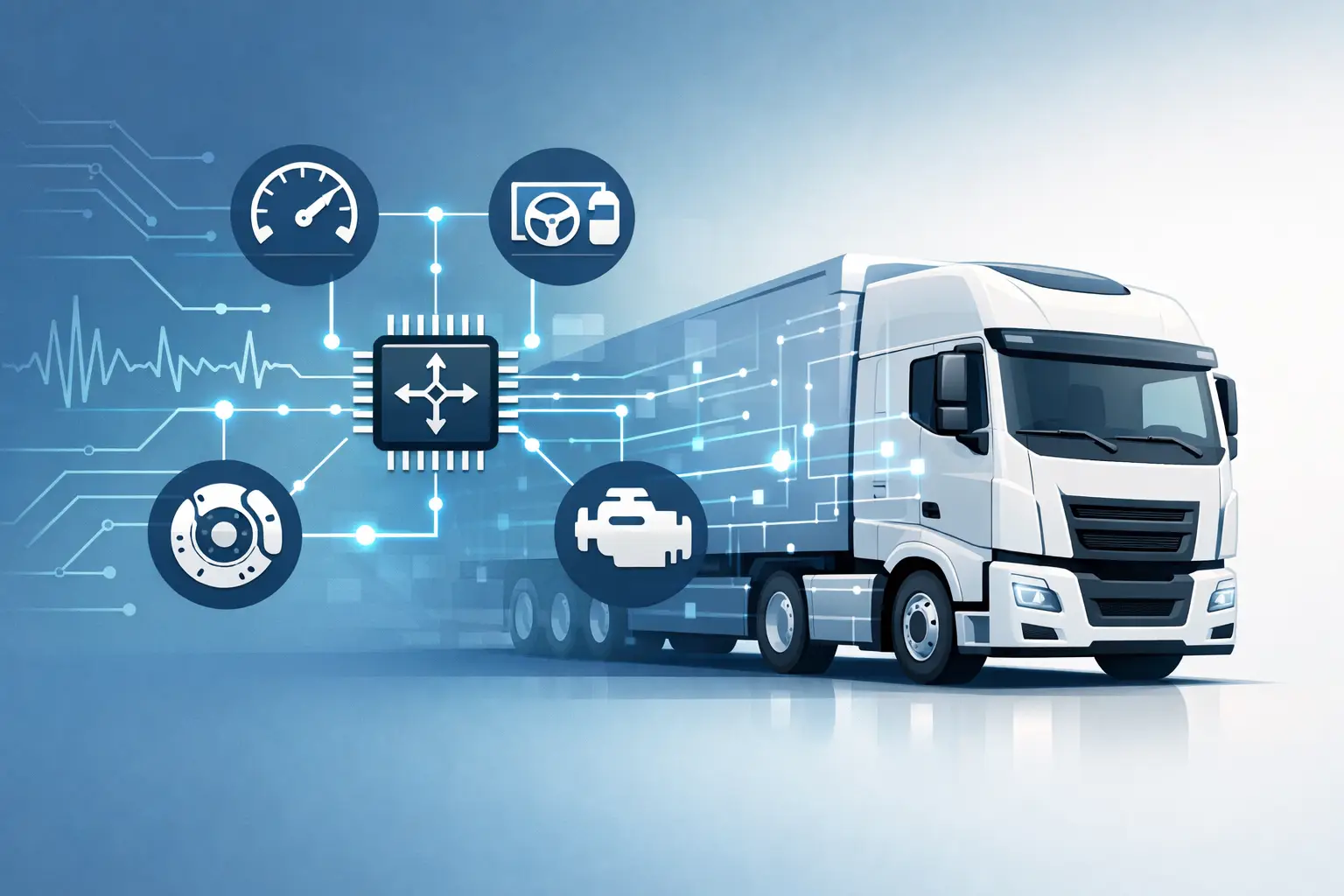
A CAN gateway is no longer a background control unit that can be ignored during diagnosis. On many EURO 5 and EURO 6 lorries, it decides which control modules can exchange data, which diagnostic requests are accepted, and whether a workshop tool can reach the ECU that requires attention. When communication is blocked, slow or incomplete, the gateway is often part of the fault path – even when it is not the original cause.
For workshops and fleet maintenance teams, understanding this unit saves time. It helps separate a genuine ECU, wiring or power-supply fault from a tool compatibility issue, a network configuration problem or a security restriction. That matters when a vehicle is off the road and a generic scan result is not enough.
What a CAN gateway does
CAN stands for Controller Area Network. It is the communication system used by electronic control units across the vehicle. Engine management, transmission, braking, dashboard, body control, suspension and emissions systems can all share information through one or more CAN networks.
The CAN gateway is the traffic controller between those networks. Rather than allowing every ECU to communicate directly with every other ECU, it routes approved messages between separate sections of the vehicle electrical architecture. A typical heavy-duty vehicle may have different networks for drivetrain functions, chassis systems, body equipment, infotainment and diagnostic access.
This arrangement has practical benefits. It reduces unnecessary network traffic, protects critical systems from lower-priority devices and allows manufacturers to control which information is shared. It also means that a fault on one branch does not always take down every electronic system on the vehicle.
In modern lorries, the gateway may also manage wake-up signals, network sleep modes, diagnostic routing and access permissions. It is therefore more than a connector between CAN lines. It is an active ECU with a defined role in the vehicle’s electronic architecture.
Why the CAN gateway affects diagnostics
A diagnostic tool connected to the standard vehicle socket does not necessarily communicate directly with the engine ECU, SCR controller or gearbox ECU. In many cases, its request first passes through the CAN gateway. The gateway then identifies the target module, routes the request to the relevant network and returns the response.
If the gateway has a power, earth, configuration or internal communication problem, the result can look like multiple unrelated faults. A technician may see several modules listed as unavailable, intermittent communication errors, incomplete vehicle identification or no response from a specific ECU.
The same symptoms can arise when the diagnostic platform does not support the required protocol or security process. This is why a basic code reader may identify generic faults but fail to provide full access to a late-model commercial vehicle. Correct connector support is only one part of the job. The tool must also support the vehicle brand, model range, model year and relevant electronic architecture.
For fleet workshops, this has a direct cost. Replacing a control unit before confirming network access can add parts cost and vehicle downtime without curing the actual fault.
Gateway-controlled access on newer vehicles
Many manufacturers have added stronger access control to later vehicle platforms. The purpose is to reduce the risk of unauthorised coding, parameter changes and security-critical functions being accessed through the diagnostic connector.
This is particularly relevant where a technician needs to carry out authorised programming, calibration, actuator tests or configuration work. A compatible professional diagnostic solution may require a valid software subscription, an approved account, online authentication or manufacturer-authorised access. The exact requirement depends on the vehicle make, model year and task.
Security is not simply an inconvenience for the workshop. It protects braking, steering, drivetrain and fleet-related systems from improper changes. The practical requirement is to choose equipment and software that supports legitimate access for the work being performed, rather than assuming every interface can perform every function.
Common CAN gateway fault symptoms
A gateway itself is not always the failed component. However, the following symptoms justify checking gateway operation and the networks connected to it:
- Several ECUs disappear from a diagnostic scan at the same time.
- Communication faults appear across different systems with no clear shared mechanical cause.
- The diagnostic socket has correct supply voltage, but the tester cannot identify the vehicle or access key modules.
- Faults are intermittent and occur after damp conditions, battery replacement, body repairs or electrical accessory installation.
- A vehicle shows battery-drain issues because one network does not enter sleep mode correctly.
- A module works locally but cannot exchange data with modules on another CAN branch.
These signs must be assessed with the fault codes, vehicle wiring information and live network measurements. A communication code alone does not confirm that the gateway has failed. Low battery voltage, poor earth points, damaged twisted-pair wiring, corroded connectors, an incorrectly installed bodybuilder connection or a faulty ECU pulling down the network can produce similar results.
A sensible workflow for CAN gateway diagnosis
Start with the basics before looking for an expensive electronic failure. Confirm battery condition and charging voltage, inspect main fuses and earth points, and check for signs of water ingress around the cab, fuse boxes and ECU locations. Heavy-duty vehicles often operate in conditions where vibration, moisture and harness damage are realistic causes.
Next, complete a full-system scan using a diagnostic platform suited to the specific lorry. Record all fault codes before clearing anything. The pattern matters: if engine, gearbox and SCR controllers are all unavailable, identify what network path they share. If one module alone is missing, focus first on that ECU’s power supply, earth, connectors and local CAN wiring.
Check whether the gateway is visible in the diagnostic session and whether it reports its own internal faults. Where manufacturer data is available, compare the expected network topology with the modules actually detected. This can quickly show whether the issue is on the diagnostic side, within a single CAN branch or across the gateway itself.
Physical CAN checks should be carried out using appropriate workshop procedures and wiring data. Resistance, voltage and signal quality must be measured correctly, with care taken not to create further faults or damage connected electronics. A shorted CAN line, open circuit or poor terminal contact can cause communication failure that appears to be a software problem.
Finally, consider recent work. Retrofit telematics, trackers, auxiliary lighting, refrigeration equipment and bodybuilder wiring are frequent areas to inspect when a previously reliable network develops intermittent faults. Any added device connected to CAN wiring must be installed correctly and remain compatible with the vehicle’s electrical system.
CAN gateway versus a diagnostic interface
These terms are often confused, but they are different components. The CAN gateway is fitted to the vehicle and manages communication between vehicle networks. A diagnostic interface is the external hardware used by the technician to connect a laptop, tablet or diagnostic platform to the vehicle.
The interface must support the right communication protocols and connector arrangement. The diagnostic software must then support the manufacturer-specific functions required for that job. A capable interface cannot compensate for unsupported software, and correctly licensed software cannot solve a damaged vehicle network.
This distinction is useful when selecting workshop equipment. For fault reading and basic live data, the required level of access may be straightforward. For commercial vehicle coding, calibration, advanced troubleshooting or guided tests, compatibility must be confirmed in greater detail. Check the make, series, engine generation, emissions standard and intended function before ordering.
Choosing equipment for gateway-equipped vehicles
For independent workshops, the right purchase is rarely the cheapest interface available. The more useful question is whether the equipment can reliably identify the intended lorry range and access the modules you service most often.
Prioritise clear vehicle coverage, regular software support and a supplier that can give practical compatibility guidance before purchase. This is especially relevant for DAF, MAN, Iveco, Mercedes-Benz, Scania, Renault and Volvo platforms, where electronic architecture and diagnostic access can differ substantially between generations.
Also consider the type of work your workshop actually performs. A fleet focused on routine servicing may need dependable fault reading, service functions and live data. A vehicle electronics specialist may require broader capabilities for configuration and guided diagnosis. Avoid buying on a feature list alone: unsupported functions, missing licences or unsuitable cables can turn a supposedly capable tool into an avoidable delay.
Truckdiag supplies specialist diagnostic and electronic equipment for commercial vehicle workshops, with product compatibility and intended application kept central to the selection process. Where a vehicle has restricted diagnostic access or an unusual electrical configuration, confirming the exact model details before purchase is the sensible route.
A CAN gateway should be treated as part of the diagnostic plan, not an obstacle discovered after hours of testing. Read the vehicle architecture, verify power and network condition, use correctly supported equipment and follow authorised procedures. That approach gives the technician the best chance of finding the actual fault while keeping the lorry, the workshop schedule and the repair bill under control.
