Have Additional Questions? Contact Us →

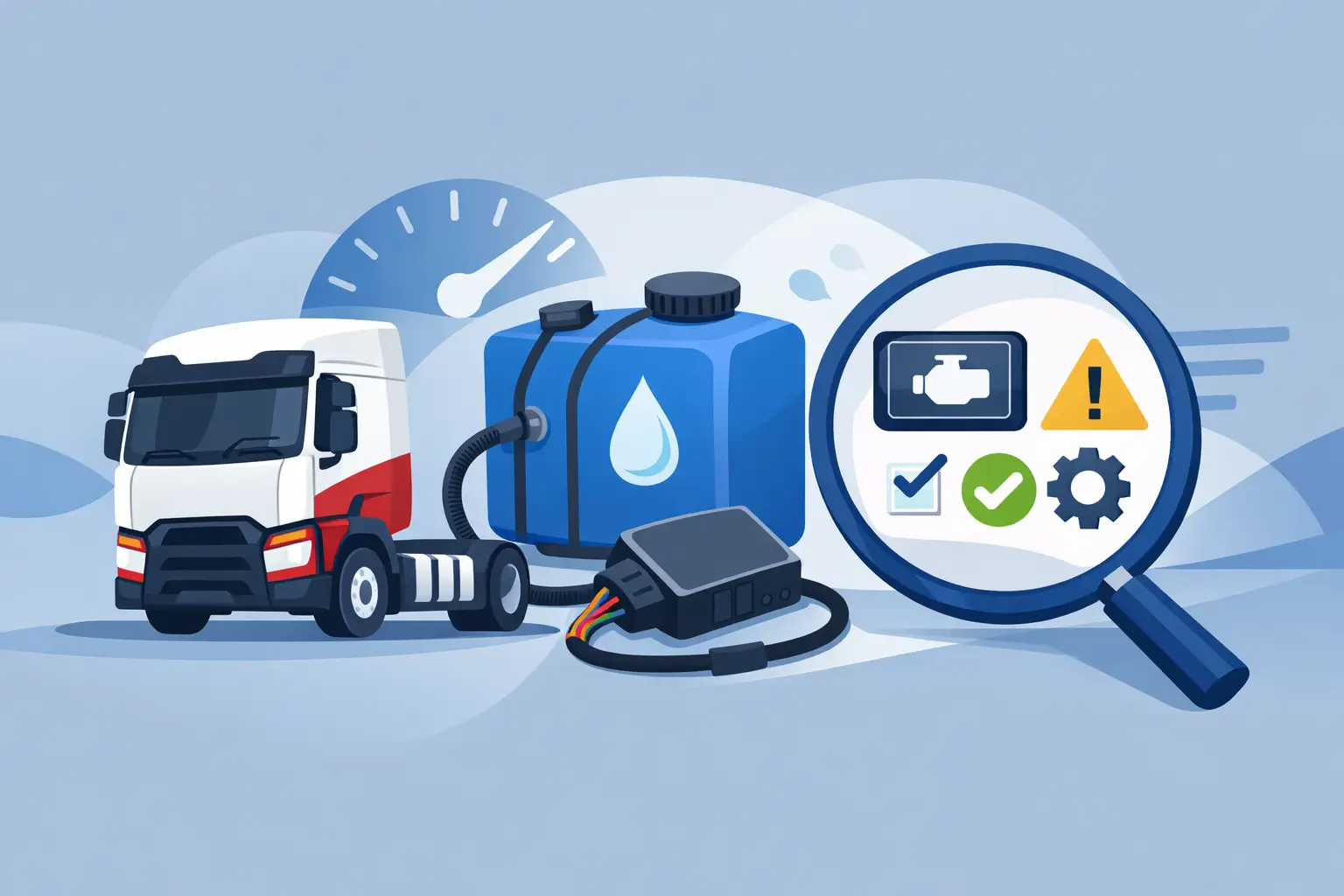
A Renault lorry AdBlue emulator usually becomes part of the conversation only after the usual route has already cost time – repeated SCR faults, derate warnings, failed regens, sensor issues, and a vehicle that will not earn until the fault is controlled. For workshops and fleet maintenance teams, the real question is not whether the warning lamp is annoying. It is whether the chosen solution is actually compatible with the Renault platform in front of you and whether it will save another return visit.
When a Renault SCR fault stops being a simple repair
On Renault heavy vehicles, AdBlue and SCR-related faults can come from several directions at once. A failed NOx sensor may be the visible fault, but the root issue may involve dosing, wiring, a faulty pump, poor quality fluid, a damaged catalyst chain, or a control strategy that has already triggered torque limitation. That is why a quick parts-swap approach often turns expensive.
For many operators, the pressure is operational rather than theoretical. If a lorry is in reduced power, parked between jobs, or repeatedly coming back with the same emissions fault, workshop time is what matters. In that context, a Renault lorry AdBlue emulator is considered as a targeted electronic intervention tool, not a generic accessory.
The key point is simple: Renault fitment has to be exact. Product choice based on guesswork is what creates wiring issues, communication faults, or non-start complaints after installation.
Renault lorry AdBlue emulator compatibility matters more than price
The cheapest unit is not the cheapest if it is wrong for the vehicle. Renault ranges cover different generations, emissions standards, engine management variants, and wiring layouts. Even within the same model family, EURO 5 and EURO 6 systems behave differently, and emulator design follows that difference.
A workshop should first confirm the lorry model, build year, engine type, and emissions class. Premium, Magnum, Midlum, Kerax and other Renault applications can require different emulator variants depending on system architecture. If the vehicle is EURO 5, the available options may differ sharply from a EURO 6 unit with more complex monitoring.
This is where professional buyers tend to save time by buying from a specialist supplier rather than a general electronics seller. Compatibility depth matters because a unit described vaguely as fitting Renault is not enough. You need to know what it is designed for, what system it bypasses, and what installation method it expects.
EURO 5 and EURO 6 are not the same job
Renault EURO 5 applications
On many EURO 5 Renault vehicles, SCR emulator solutions are relatively straightforward compared with later systems, but that does not mean every unit is interchangeable. Pinout differences, connector styles and programming logic still matter. A correct EURO 5 emulator should be matched to the vehicle platform and installed in line with the supplied instructions.
In practice, buyers usually want a solution that clears persistent SCR-related limitations without needing repeated sensor replacement. That can be a sensible approach where the system has already become uneconomical to repair in the normal way.
Renault EURO 6 applications
EURO 6 is a different level of complexity. Monitoring strategies are tighter, and mistakes show up faster. A Renault lorry AdBlue emulator for EURO 6 has to be selected much more carefully because these vehicles can involve broader sensor logic, stricter engine management interaction, and less tolerance for installation errors.
For that reason, experienced workshops do not treat EURO 6 as a universal plug-and-play exercise. They verify the exact application first, then check whether the emulator is vehicle-specific, what wiring intervention is required, and whether additional setup or coding steps are involved.
What to check before you order
The right buying process is technical, not promotional. Before placing an order, confirm the vehicle identification details, emissions class, and the exact fault pattern. If the issue is SCR-related but there are unrelated CAN, power supply or engine ECU faults present, those should be understood first. An emulator cannot correct underlying electrical damage elsewhere in the vehicle.
You should also check whether the unit is intended specifically for Renault and whether the listing clearly separates EURO 5 from EURO 6 coverage. If the product information is vague, that is already a warning sign. Buyers working on commercial vehicles need clarity on fitment, not marketing language.
Installation format is another practical point. Some emulators are designed around direct connector integration, while others may require more involved wiring. For a busy workshop, the time difference matters. So does access to technical guidance if the vehicle has already had previous electrical work carried out.
Common workshop mistakes with Renault emulator jobs
The first mistake is ordering by model name only. A Renault Premium badge on the front of the vehicle does not tell you everything you need to know. The same model line may span different years and different emissions-system configurations.
The second mistake is assuming every SCR fault justifies the same intervention. If the vehicle has multiple live faults outside the AdBlue system, fitment may not deliver the expected result until those are resolved. Power supply integrity, damaged connectors and poor previous repairs can all interfere.
The third mistake is underestimating installation discipline. Even a correct unit can produce poor results if wiring is rushed, if connectors are left vulnerable to moisture, or if instructions are ignored. This is workshop hardware, not a universal consumer gadget.
Why professional buyers choose specialist supply
For fleet teams, independent mechanics and resellers, the value is not just the part in the box. It is confidence in what arrives. A specialist supplier can usually give clearer information on Renault coverage, stock availability and whether a product suits a known EURO 5 or EURO 6 application.
That matters when a vehicle is already off the road. Fast shipping, secure payment, and expert guidance by email are not extras in this sector. They directly affect downtime and customer satisfaction. A workshop that orders the right Renault emulator first time avoids a second delay, a second fitting slot and a difficult call with the end customer.
Truckdiag works in that specialist space, which is why the product range is focused on commercial vehicle electronics rather than general aftermarket parts. For buyers dealing with Renault SCR issues, that level of focus is usually more useful than a broad catalogue with limited fitment detail.
Renault lorry AdBlue emulator installation expectations
A realistic installer expects a technical job, not magic. The vehicle should be assessed properly, battery condition and voltage stability should be sound, and any obvious wiring damage should be addressed before fitment. On some vehicles, access is straightforward. On others, routing and loom condition can turn a short task into a longer one.
It also helps to record the fault state before installation. That gives the workshop a baseline and avoids confusion later. If the lorry already has a history of intermittent communication faults or poor-quality electrical repairs, that should be documented from the start.
After fitment, the sensible approach is to check system behaviour, confirm that expected warnings are handled correctly, and make sure the vehicle is responding as intended. Workshops familiar with diagnostics know this already, but it is worth stating because repeat jobs often come from skipping the verification step.
Buying the right unit the first time
A Renault lorry AdBlue emulator is worth considering when SCR-related downtime is costing more than the repair path is realistically worth, but the decision only pays off if the part is matched correctly. That means checking Renault model coverage, EURO class, installation type and the quality of technical support behind the product.
For professional users, the target is straightforward: reduce downtime, avoid compatibility mistakes and fit a proven solution that suits the exact vehicle. If you start with those checks instead of starting with the lowest price, you usually end up with the better result – for the workshop and for the operator waiting to get the lorry back on the road.
If you are ordering for a Renault application, take an extra minute to verify the platform details before you buy. That small step is often the difference between a clean job and another vehicle stuck in the yard.
