Have Additional Questions? Contact Us →

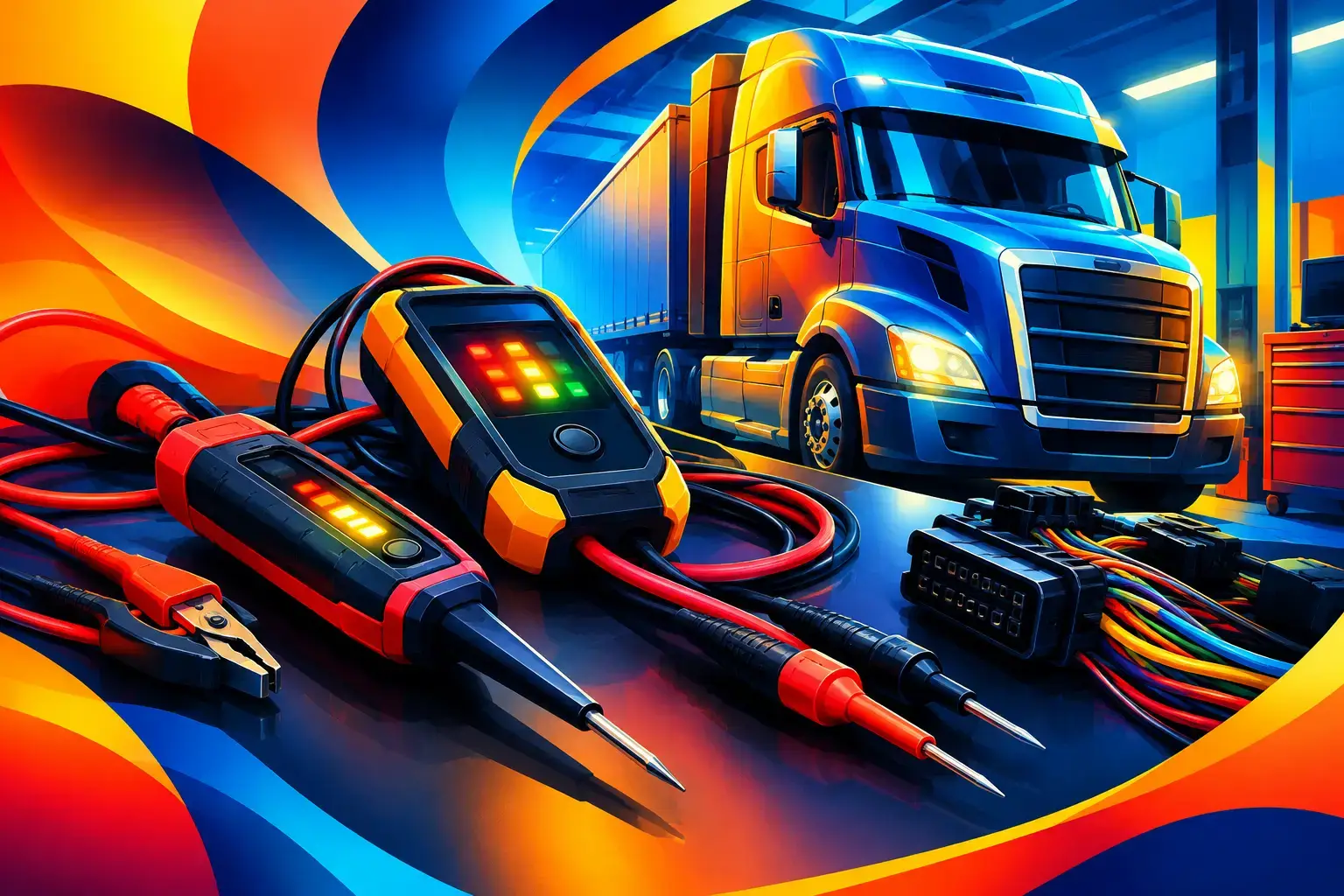
A lorry can lose a day’s work over a corroded earth point, a broken wire inside a chassis loom or a trailer socket with one weak terminal. The top lorry wiring testers help a workshop prove where the fault is before parts are ordered, looms are opened or control units are blamed. For commercial vehicle work, that means choosing equipment designed for 12V and 24V systems, long cable runs and electronically controlled circuits.
A basic test lamp still has a place on older vehicles, but it is not enough for a EURO 5 or EURO 6 fleet. Modern DAF, MAN, Iveco, Mercedes-Benz, Scania, Renault and Volvo vehicles combine conventional power circuits with CAN networks, sensors and ECU-controlled outputs. The right tester must give useful results without putting sensitive electronics at risk.
What makes a wiring tester suitable for lorries?
Passenger-car testers can be useful for simple checks, but commercial vehicles demand more from the equipment. Chassis lengths are greater, battery systems may run at 24V, trailer connections add another set of circuits, and poor grounds are common where moisture and road contamination reach connectors.
Start with voltage range. A tester that is limited to 12V is unsuitable for much heavy-duty work. Look for clear 24V capability, properly insulated leads and a construction that will withstand daily workshop use. Long, flexible leads are not a luxury when testing rear lights, side markers, lift axles or bodybuilder connections.
The other consideration is circuit type. A conventional filament-lamp circuit can be checked with a load-bearing test lamp. An ECU output, sensor reference line or CAN circuit needs a high-impedance digital multimeter or an oscilloscope. Applying a loaded probe to the wrong wire can create a fault that was not there at the start of the job.
Top truck wiring testers by workshop task
There is no single best tester for every electrical fault. A productive workshop normally uses several tools, each for a defined job. Buying one multi-purpose device can be sensible for mobile repair work, but dedicated equipment is often quicker and safer at the bench.
1. Digital multimeter for measured diagnosis
A quality digital multimeter is the core electrical tool. It measures battery voltage, voltage drop, resistance, continuity and current where the meter and leads are rated for the work. For lorry diagnostics, choose one with a reliable 24V operating range, fused current inputs and a clear display that remains readable in poor light.
Voltage-drop testing is where a multimeter earns its place. A circuit may show 24V with no load, yet fail as soon as a lamp, motor or solenoid is connected. Measuring between the battery negative and the component earth while the circuit operates will reveal resistance that a simple continuity test can miss. This is especially useful for starter circuits, lighting grounds, ABS wiring and corroded chassis connections.
Resistance readings should be used carefully. Disconnect the circuit from its power source and, where necessary, isolate control units before measuring. A low resistance reading does not always prove that a wire can carry load, particularly on an ageing loom with corrosion hidden beneath insulation.
2. Heavy-duty test lamp for loaded circuits
A 24V test lamp remains one of the fastest tools for checking fuses, feeds, earths and conventional lighting circuits. It gives an immediate visual indication and places a small load on the circuit. This can expose weak terminals that make a multimeter appear reassuringly normal.
Use a suitable lamp on trailer lighting, body electrics, relay outputs and basic switched supplies. It is also useful when checking whether both sides of a fuse have a usable feed. However, it should not be used indiscriminately on low-current sensor circuits, ECU pins or data wiring. The speed of a test lamp is valuable only when the technician understands the circuit being tested.
3. Power probe and circuit tester for active checks
A power probe-style circuit tester can supply power and earth, display voltage and test continuity from a single handheld unit. For fault-finding in lamps, motors, relays, horns and body equipment, this can reduce diagnosis time considerably. It allows the technician to test the component and its supply without repeatedly moving between the battery, fuse board and rear chassis area.
For commercial use, confirm that the unit is rated for 24V operation and has adequate protection against short circuits and overload. A unit designed only for light vehicles is a poor match for a heavy-duty workshop. Active circuit testers are particularly practical for checking trailer lamps, auxiliary body functions and suspected open circuits, but they are not a substitute for manufacturer wiring diagrams or diagnostic software.
4. Trailer socket and lighting tester
Trailer electrical faults are often intermittent and time-consuming. A dedicated trailer socket tester provides a quick first check of supply and output at the tractor unit, while a lighting tester can help isolate whether the issue is in the towing vehicle, trailer lead or trailer loom.
The correct tester depends on the connector and application. Seven-pin lighting sockets, 15-pin systems and ISO 7638 ABS/EBS connections require different checks. Do not assume a lighting tester can validate an ABS/EBS supply or communication circuit. For those systems, use the correct diagnostic equipment and follow the vehicle and trailer manufacturer procedure.
5. Back-probe leads and breakout accessories
The tester itself is only half the setup. Fine back-probe pins, fused leads, crocodile clips and breakout cables make testing more accurate and reduce the temptation to pierce insulation. Piercing a wire may provide a quick reading, but it can leave an entry point for water and corrosion – a future fault waiting to happen.
For fleet workshops, keeping dedicated leads for battery, trailer and low-voltage signal work prevents damaged probes from being used on sensitive circuits. Replace worn leads promptly. A damaged meter lead can produce misleading measurements or create a direct short in a confined connector area.
How to choose between a test lamp, meter and power probe
Choose according to the fault, not personal habit. A no-start complaint may require battery voltage checks, voltage-drop measurements and current testing. A rear lamp fault may be solved quickly with a test lamp and a trailer socket tester. An intermittent sensor code may need a multimeter, wiring diagram and, in some cases, an oscilloscope.
The following points should be confirmed before buying a tester for commercial work:
- 12V and 24V compatibility for mixed fleets and trailer work.
- Fused, correctly rated leads and protection against accidental short circuits.
- Suitable probes and cable length for chassis, cab and trailer testing.
- Clear specifications for current, continuity and voltage measurement.
- Availability of replacement leads, probes and accessories.
A workshop carrying out regular vehicle electronics work should also consider diagnostic coverage. A wiring tester proves the electrical condition of a circuit. A diagnostic tool identifies fault codes, live values, actuator tests and ECU communication faults. Used together, they prevent guesswork. A code for a pressure, temperature or NOx-related issue does not automatically mean the sensor has failed; the supply, ground, connector condition and harness must be checked first.
A practical test sequence that avoids wasted time
Begin with the complaint and verify it. If a driver reports an intermittent trailer light, connect the trailer and reproduce the issue before dismantling anything. Check battery condition and main grounds early, because low system voltage can create multiple misleading fault codes across different control units.
Next, inspect connectors and loom routing. Look for water ingress, green corrosion, stretched wiring near articulation points, chafing against brackets and previous repairs hidden under tape. Then check the relevant fuse and relay under load, rather than relying only on visual inspection.
Use the wiring diagram to identify the expected supply, earth and signal values. Test at the component first, then work back towards the source if the result is wrong. This approach narrows the fault quickly and avoids removing trim or opening harnesses without evidence.
When working near ECUs, disconnecting connectors, using breakout leads or testing communication lines, follow the manufacturer procedure. Isolate power where required and do not short adjacent pins with oversized probes. Careful testing protects expensive modules and keeps the repair defensible when the vehicle returns to service.
Build a tester kit around the vehicles you service
A small operator maintaining older lighting and trailer circuits may need a reliable 24V test lamp, multimeter and socket tester. A workshop handling modern fleet vehicles needs more: active circuit testing, quality leads, wiring information and lorry diagnostic equipment capable of accessing the relevant systems.
Truckdiag supplies specialist equipment for commercial vehicle diagnostics and electronics work, with compatibility-focused options for major European lorry brands. The best purchase is not necessarily the tester with the longest feature list. It is the one that safely matches the voltage, connectors and systems your workshop sees every day.
Start with accurate measurements, test under load where appropriate and treat wiring diagrams as part of the tool kit. That is how a wiring tester becomes a faster repair, fewer repeat visits and less vehicle downtime.
